Garment embroidery, your specification
Made to your tech pack, fabric and colours by a factory matched to the order.
Private label
Your main label, care label, hangtag and polybag. Nominated trims accepted.
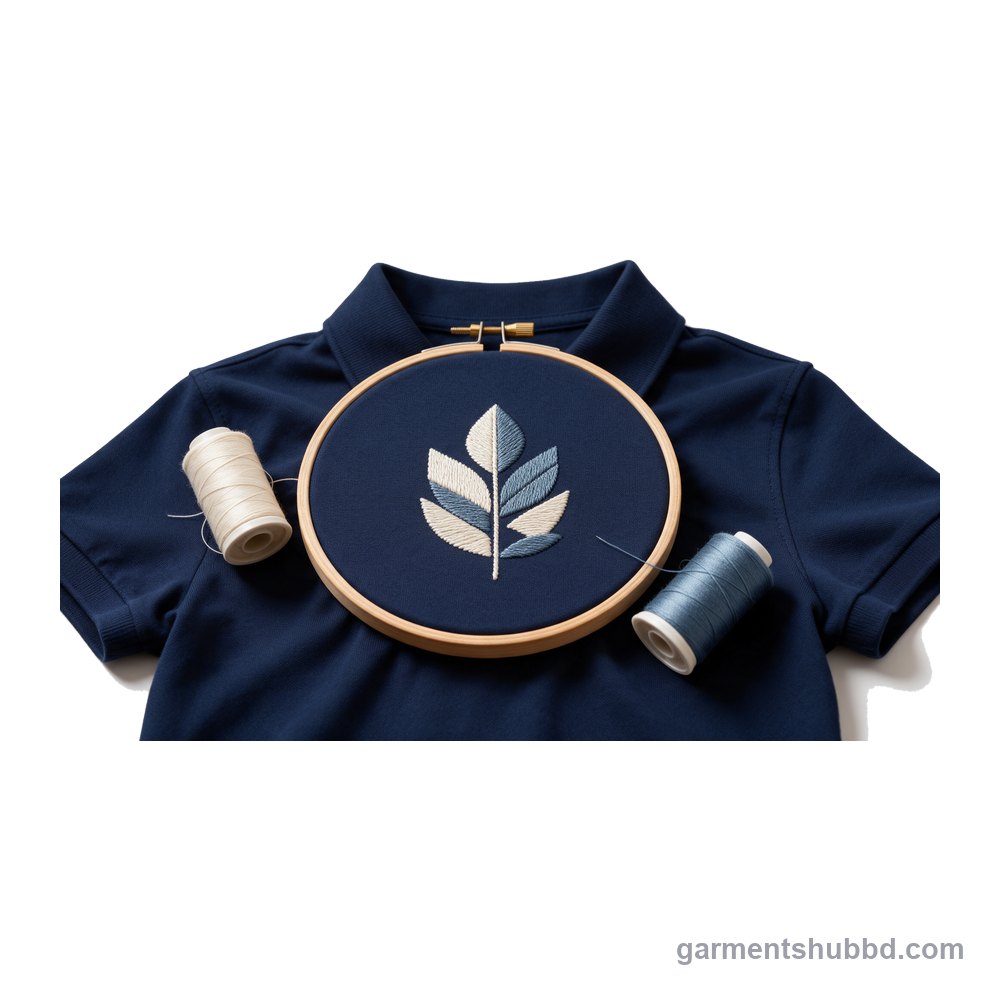
Embroidery is decoration in thread, stitched by multi head machines from a digitised file. In many knit and uniform plants an embroidery section or a nearby unit stitches cut panels before sewing, or finished garments when the position needs it. Garment embroidery services in Bangladesh therefore follow the garment, and the stitch file, the backing and the position are settled with the garment's own sample.
Factories on the bench quote embroidery with the garment as its own line, priced by stitch count and position, so two quotes compare stitch for stitch. The printing page covers ink; this page covers thread. Position and thread colour are checked at inline and final inspection against the approved stitched sample.
Kinds of garment embroidery
Flat embroidery
Satin, fill and running stitches lying flat on the cloth, for most logos, crests and text. Small lettering keeps its shape in satin stitch; large solid areas use fill.
3D puff embroidery
Satin stitches laid over foam to raise the design. It suits bold letters and simple shapes on caps, hoodies and jackets; fine lines and small counters collapse.
Appliqué
A shaped piece of twill, felt or contrast cloth stitched down with a satin border. It covers a large area with far fewer stitches than a solid fill.
Chenille
Looped, towel textured embroidery from a chenille machine, usually varsity letters and patches. A separate machine type, so the work often goes to a specialist unit.
Badges and patches
The design stitched on a base cloth, cut out and edged, then sewn or heat sealed onto the garment. The route for thin or stretchy cloth that cannot carry a dense design directly.
Cap embroidery
Front logos stitched on a cap frame that holds the curved crown, or on flat panels before the cap is built. Caps themselves come through units found for the enquiry.
What to send for garment embroidery
- Artwork and finished size
- Vector artwork with the finished width and height for each position and size range. Text much smaller than about 5 mm high fills in, so simplify it before digitising.
- Stitch file
- An existing machine file if you hold one, or a request for digitising; either way, the stitch count. A file made for one cloth often needs editing for another.
- Thread
- Polyester thread keeps its colour through bleach and industrial washing; rayon thread has more sheen but less wash resistance. Pick colours from the thread card.
- Backing and topping
- Cut away backing for knits and stretch cloth, tear away for stable wovens, and a water soluble topping on pile and fleece so stitches sit on top.
- Garment and position
- Garment, cloth and colour, and each position measured from a fixed seam. Seams, pockets and zips limit where the hoop can sit.
- Pieces per design
- Quantity for each design and position. Digitising and set up are paid once per design, so many small designs cost more than one larger run.
Tests for garment embroidery services in Bangladesh
- ISO 105-C06 or AATCC 61
- Washing fastness of the thread, read for staining onto the cloth around the design. Red and navy thread on white garments is where bleeding shows.
- ISO 15797
- Industrial laundering of workwear. For uniform embroidery, ask that thread and backing were tested through industrial cycles, which are harsher than a home wash.
- OEKO-TEX STANDARD 100
- Covers thread and backing as components. On baby and children's garments, ask that the certificate names the embroidery thread, not only the garment cloth.
What moves the price of garment embroidery
- Stitch count, usually charged per thousand stitches, the largest cost in any design.
- Positions per garment, each needing its own hooping and machine run.
- Digitising, paid once per design and size and not again on repeat orders.
- Special work: foam for puff, cloth for appliqué, and bought in chenille or badges.
- Run length per design, since set up and thread changes spread over fewer pieces on short runs.
Lead time for garment embroidery
Embroidery adds digitising and a stitch out before the garment sample, usually a few working days when the artwork is final. Panels are embroidered between cutting and sewing, so a dense design across a large order can add several days to bulk. Chenille and badges from a separate unit add their own making time. A late artwork change means a new file and a new stitch out, and the quote dates each step.
What we check in garment embroidery
- Coverage and trimmingFills and satin columns are checked for gaps where the cloth shows through, loose loops and untrimmed jump stitches.
- Position against specEach design is measured from its fixed seam on sampled pieces in the smallest and largest sizes.
- Cloth around the designThe cloth around each design is checked for puckering and rippling on the face, and the backing for neat trimming inside.
- Thread colour by positionThread colours in every position are compared with the approved stitched sample and the thread card under one light.
Questions buyers ask about garment embroidery
Can embroidery go on thin or stretchy fabrics?
Yes, with care. Thin jersey and stretch cloth need a cut away backing and a lighter, more open design, or the knit puckers around it. A very dense design on fine cloth is better made as a badge and sewn on. Test on the bulk fabric, not a heavier swatch.
Does every garment need a new stitch file?
Often an edit rather than a new file. The same logo on pique, fleece and a cap front needs different density, underlay and pull compensation, because each cloth moves differently under the needle. Keep every approved file by cloth and size for repeat orders.
Will embroidery survive industrial washing on uniforms?
Yes, with polyester thread, a secure backing and a design that is not overly dense. Rayon thread loses colour in bleach and hot industrial washes. Ask for an ISO 15797 test on the embroidered garment if your uniforms go to a commercial laundry.
Embroidery or print for a logo?
Embroidery for small chest marks, caps and uniforms, where it reads as durable and outlasts most prints. Print for large graphics, fine detail and photographic art, which thread cannot reproduce and would make stiff. Many garments carry both: a stitched chest mark and a printed back.
Get a quote for garment embroidery
Tech pack or sketch with quantities per colour. A compared quote in 48 hours.