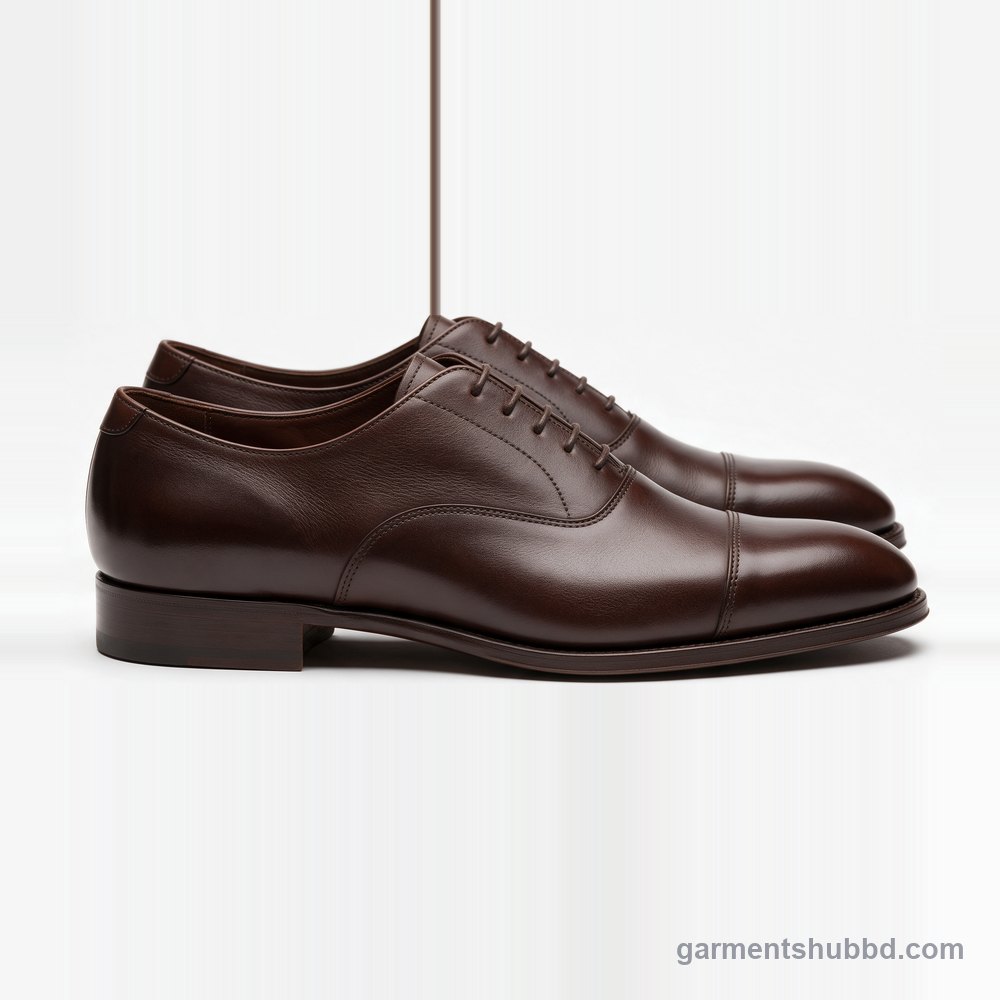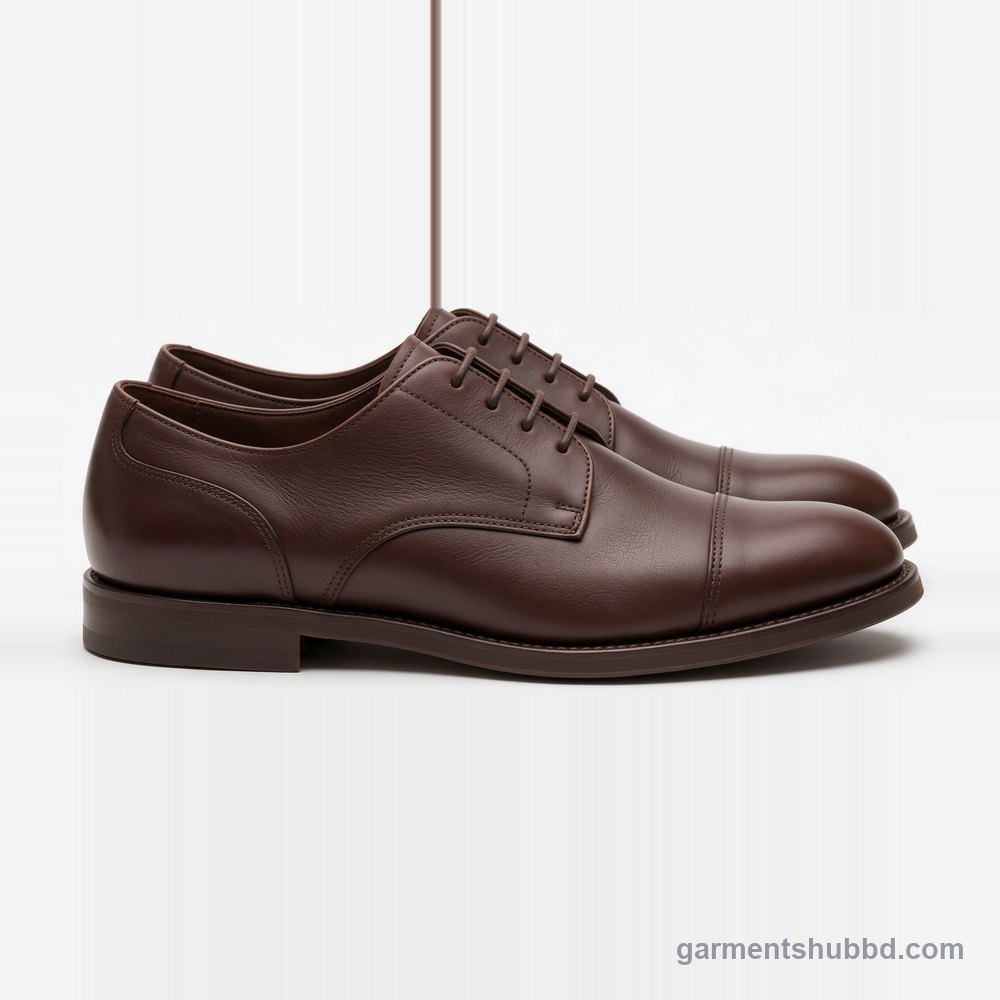
Derby shoes, your specification
Made to your tech pack, fabric and colours by a factory matched to the order.
Private label
Your main label, care label, hangtag and polybag. Nominated trims accepted.
A derby has open lacing: the quarters that carry the eyelets are stitched on top of the vamp, so they spread apart as the laces are tied. That leaves room over a high instep and a fuller foot, so one derby last fits more customers than a closed pattern. Brands come to a derby shoe manufacturer in Bangladesh for a familiar leather shoe in dress and casual versions.
Garments Hub BD has not vetted a footwear unit yet. For a derby enquiry the desk shortlists units by the construction you name, sees their lasting and sole rooms working on derbies, visits the one that can run your pattern, and comes back within 5 working days with a real quote or a straight no.
Kinds of derby shoe
Plain toe derby
One vamp, two quarters and no decoration. It cuts economically from a hide and closes quickly, so it is the usual opening style for a new range and a fair test of a unit's lasting.
Split toe derby
A raised seam runs over the toe, joining the vamp to an apron, sometimes hand stitched. It reads casual and outdoor, suits pull up and oiled leathers, and costs more because the toe seam is skilled work.
Longwing brogue derby
The wingtip runs right round the shoe to the heel, with punched holes along every seam. More pattern pieces and more punching add clicking time and leather, so price it against a plain derby, not in place of one.
Lug or crepe soled derby
A casual derby on a thick rubber or crepe sole, usually cemented or stitch-down. It carries a heavier upper and suits younger ranges, but the sole is bought in, so its colours and supply decide the dates.
What to send a derby shoe manufacturer in Bangladesh
- Construction
- Name it first: cemented for price and light weight, Blake for a slim edge, Goodyear welted for a shoe that can be resoled. Each needs different machines, so it decides which unit can quote.
- Last and instep
- Your own last or a pair to copy. On a derby, the facing gap with the laces done up shows whether the last suits the pattern and your customers' insteps.
- Upper leather
- Animal, layer, tannage and finish: full grain calf, corrected grain, suede or pull up, usually 1.2 to 1.6 mm thick for a derby upper.
- Lining and stiffeners
- Leather or textile lining, plus the toe puff and heel counter material. A leather lining and a moulded counter cost more and keep the shape longer.
- Sole and heel
- Leather, rubber, or leather with a rubber top piece, the edge colour, and the heel height, usually 2.5 to 3 cm on a men's derby.
- Size run
- Size system, the run, pairs per size and the width fitting. Open lacing lets one fitting cover a broader range of feet, which keeps a first run simpler.
Tests and certificates for derby shoes
- Sole adhesion test
- A peel test pulls the sole away from the upper and records the force and where the bond failed. Ask for it on every cemented derby; on Blake and Goodyear builds the stitching backs up the adhesive.
- Upper flex test
- The upper is creased through many cycles at the vamp and checked for cracks in the grain or the finish. It finds a leather fault before a customer does.
- REACH Annex XVII, entry 47
- A derby's leather lining sits against the foot all day, and for the EU it must not exceed 3 mg/kg of chromium VI. Ask the tannery for a result on the lining and the upper.
- amfori BSCI
- EU shoe buyers often ask for this social audit of the factory. Ask the derby unit for its latest report and audit date; the tannery is a separate site with its own audit.
What moves the price of a derby shoe
- Construction: Goodyear welting costs well above cemented work, with Blake stitching in between.
- Leather: full grain calf against corrected grain, and how much hide the cutting pattern wastes.
- A leather lining and a leather sole in place of textile and rubber.
- Your own last, which has to be made in every size before the first pair is lasted.
- Broguing, a split toe seam or contrast stitching, each adding clicking or closing time.
- Thin runs across many sizes, which cost more per pair than a run concentrated in the middle sizes.
Lead time for derby shoes
A derby sample usually takes 21 to 30 days once leather and last are agreed, and bulk typically 60 to 90 days after the pre-production pair is approved in writing. A new last in your size run adds time before the first sample, and a Goodyear welted order spends longer at the welting and finishing stages than a cemented one. A custom leather colour from the tannery also adds days. The quote confirms each figure.
What we check on derby shoes before shipment
- Facing gapLaced up, the gap between the quarters is even from top to bottom and matches on the left and right shoe.
- Eyelet backingEach eyelet is reinforced behind the facing, so a hard pull on the laces cannot tear through the leather.
- FeatherlineOn cemented pairs there is no gap and no adhesive overspill where the upper meets the sole edge, checked all the way round.
- Sole stitchingOn Blake and welted pairs the stitch spacing is even, the line is straight and the sole channel is closed over the thread.
Questions buyers ask about derby shoes
Is a derby easier to fit than an oxford?
Usually, yes. The quarters sit on top of the vamp and open with the laces, so the same last fits a wider range of insteps. That makes the derby the safer choice for a range sold online, where returns for poor fit are the cost to watch.
Which construction should a first derby order use?
Cemented keeps price and lead time down and suits casual derbies on rubber soles. Blake gives a slimmer edge for a dress derby. Goodyear welting is worth it only if the shoe is priced to be resoled, and it narrows the choice of units sharply.
Can I use my own last?
Yes, and it is a reliable way to keep the fit consistent with shoes you already sell. Lasts are made per size, so your own set is a real cost. A unit's stock last is cheaper and can often be adjusted to your pattern and toe shape.
How is the minimum split across sizes on a derby?
Across your size run in the proportions you set, usually heavier in the middle sizes and lighter at the ends. Send the run and pairs per size with the enquiry, because some units also set a floor per size, not only per colour.
Get a quote for derby shoes
Tech pack or sketch with quantities per colour. A vetted unit and a real quote, or a straight no, within 5 working days.