Dresses, your specification
Made to your tech pack, fabric and colours by a factory matched to the order.
Private label
Your main label, care label, hangtag and polybag. Nominated trims accepted.
Dresses are bought by cloth before silhouette. A printed viscose maxi, a poplin shirt dress and a jersey T-shirt dress share a rail, yet each comes from a different floor: the viscose print plant, the shirting plant and the knit plant. A dress manufacturer in Bangladesh for a full range is really three, held together by one print, colour and size standard. Denim dresses have their own pages.
Garments Hub BD sends each cloth group of your range to plants that already cut it, with the same master chart and colour references for all of them. When one print runs on viscose for one dress and on poplin for another, both strike offs are sent back for approval together, so the colourway matches across the rail.
Kinds of dress
Printed viscose dresses
Wrap, tiered, maxi and midi shapes in viscose challis or crepe, which drapes well and takes print in clear colour. It shrinks and slides on the cutting table, so it is tested before the pattern is final.
Cotton poplin and lawn dresses
Crisp, light woven cotton for summer shapes, smocked bodices and tiered skirts. Pale shades can show through, so lining or a separate slip is settled at the first sample.
Linen and linen blend dresses
Relaxed shift and button front shapes in linen or linen viscose, usually washed for a soft hand. Creasing belongs to the look and is written into the quality standard.
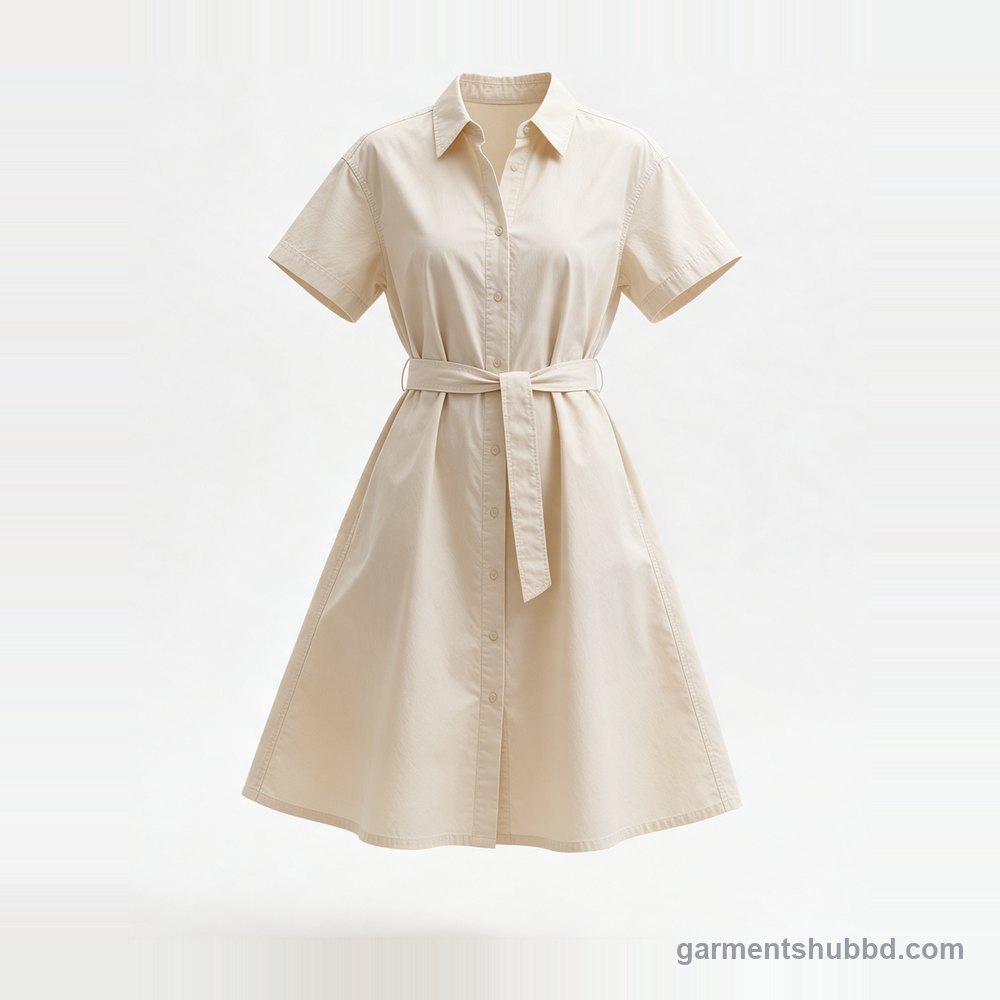
Shirt dresses
Collar, placket and cuffs on a dress length body, sewn on a shirting line that stitches collars all day. Button spacing at the bust is set per size so the front does not gape.
Jersey T-shirt dresses
Single jersey or viscose elastane jersey, usually 160 to 220 GSM, cut on a knit plant. Quick to make and simple to grade, though the hem twists if the jersey spirals.
Girls' dresses
The range in children's sizes, graded by height rather than bust, with ties, sashes and buttons held to children's safety rules for each market.
What to send a dress manufacturer in Bangladesh
- Cloth and weight
- Fibre, weave and weight for each dress, usually 90 to 130 GSM for viscose and poplin. Light cloth decides lining, seam type and how pale shades read.
- Print artwork and repeat
- Files with repeat size and colourways. Rotary screen print needs a run of metres per design; digital print suits short runs at a higher cost per metre.
- Lab dip on the dress cloth
- Approve solid shades on the dress fabric itself. Thin viscose and poplin read lighter on the body than a folded swatch of heavier cloth.
- Fullness and length
- Gather ratio for each tier, skirt sweep, and length from the high point shoulder for every size. Fullness moves fabric use more than any other choice.
- Master size chart
- One chart in one system, with grade steps for bust, waist, hip and length. The factory grades from it and prints the UK, EU and US conversions on the label.
- Ties and closures
- Concealed zips, buttons, shoulder ties, waist sashes and elastic, with colours. On girls' sizes state every tie length and where it is fixed.
Tests and rules for dresses
- ISO 13936
- Seam slippage in woven fabric. Viscose crepe and challis pull away from the stitching at waist and side seams, so ask for a result on the bulk cloth.
- ISO 5077 with ISO 6330
- Dimensional change in washing. A few percent of length lost in viscose turns a midi into a shorter dress, so test before the pattern is cut.
- EN 14682
- Neck ties, shoulder ties and waist sashes on girls' dresses sold in the EU must meet its limits on cord length and position.
- US CPSIA
- Girls' dresses for age 12 and under need a permanent tracking label, third party testing at a CPSC accepted laboratory and a Children's Product Certificate; lead testing falls on buttons, prints and coatings.
What moves the price of a dress
- Fabric per dress: a tiered maxi can take close to twice the cloth of a straight midi.
- Print route: rotary screen carries a set up per design, digital print a higher cost per metre.
- Gathering, smocking and shirring, which add sewing time on every tier and bodice.
- A lining or separate slip for pale and sheer cloth.
- Size spread: girls' and extended sizes need their own grading and markers.
Lead time for dresses
A printed dress waits on its print. A strike off on the bulk viscose or poplin usually takes several working days and is approved before the full length is printed; rotary printing then adds mill days. Solid dresses need a lab dip on the real cloth instead. Washed linen adds a stage after sewing, and girls' dresses for the US add a laboratory test. The quote dates each step.
What we check on dresses before shipment
- Print placementLarge motifs are checked for position at the chest and centre front, and prints matched across the front seam where the spec asks for it.
- Hem level on full skirtsTiered and bias cut hems are hung and checked for level, since viscose drops unevenly after cutting.
- Pale shades against lightPale dresses are held to the light for see through and for pocket bags or seam allowances shadowing on the front.
- Ties on girls' sizesTie and sash lengths are measured against the stated limits, and their attachment points pulled to check they hold.
Questions buyers ask about dresses
Can one print run across viscose and cotton dresses?
Yes, as two strike offs, one on each cloth, because viscose and cotton take dye differently. Approve them side by side under one light. Viscose usually prints a little brighter and softer, poplin crisper and flatter, and the colourway is balanced between them before bulk.
Why does a viscose dress shrink more than a cotton one?
Viscose fibre swells when wet and relaxes as it dries, so unfinished viscose can lose noticeably more length than poplin. The factory tests the bulk cloth, sets the pattern allowance and confirms it on a washed sample. Midi and maxi lengths show any shortfall first.
How are UK, EU and US sizes handled in one dress range?
One master chart is graded, and each label carries its conversions, for example UK 10, EU 38 and US 6. Conversions are approximate, so fit to the system of your largest market. A separate chart per market multiplies patterns, markers and the chance of error.
Should a light summer dress be lined?
Only where the cloth or colour shows through. White and pastel poplin or viscose usually needs a bodice lining or a full slip; prints and darker shades often need none. Decide on the first sample in daylight, since lining adds cloth, sewing and weight.
Get a quote for dresses
Tech pack or sketch with quantities per colour. A compared quote in 48 hours.