Formal leather belts, your specification
Made to your tech pack, fabric and colours by a factory matched to the order.
Private label
Your main label, care label, hangtag and polybag. Nominated trims accepted.
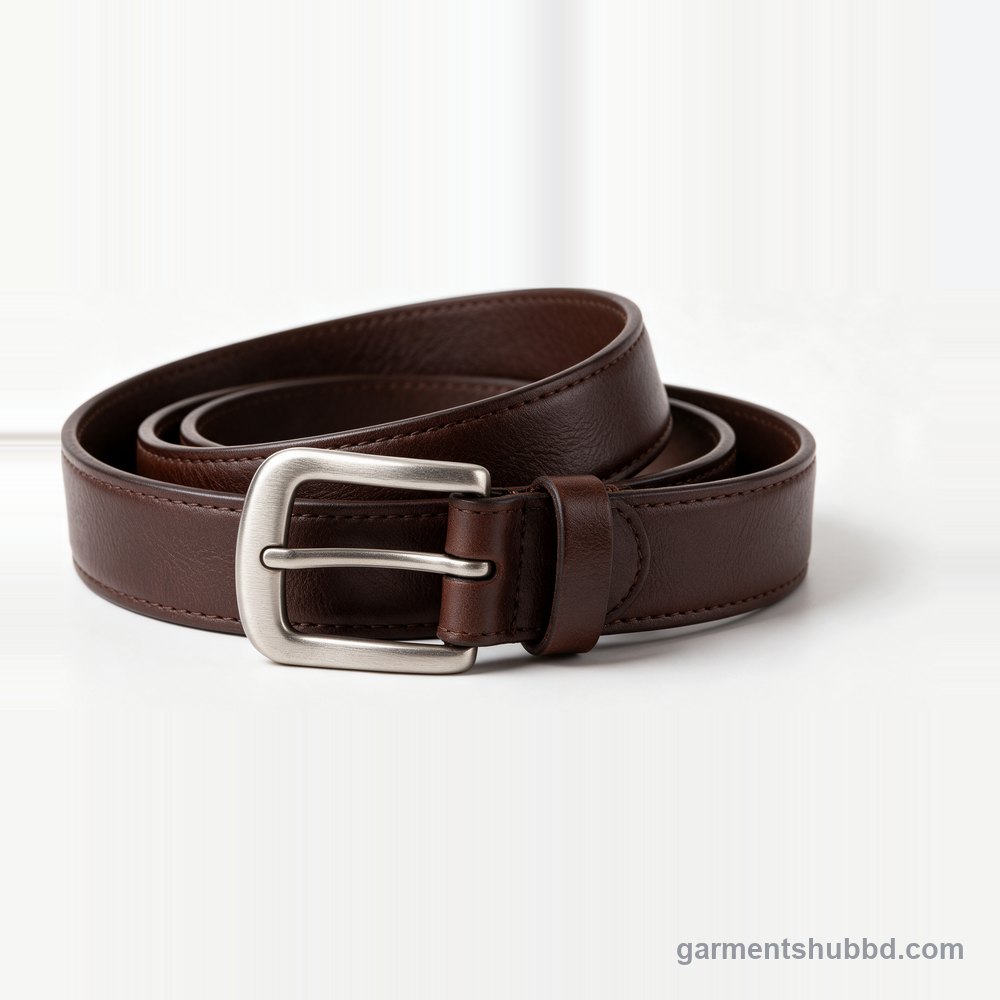
A formal belt is the narrow, smooth belt worn with suit and dress trousers, usually 30 to 32 mm wide, in black or dark brown to match the shoes. Menswear brands, tailoring labels and department store ranges buy it alongside suits and shirts. A formal leather belt manufacturer in Bangladesh is judged on details a shopper sees at arm's length: an even edge, straight stitching and a buckle that sits flat against the waistband.
Belts have no unit lined up in advance at Garments Hub BD. For a formal belt enquiry the desk finds a unit that already finishes dress belt edges to a retail standard, vets and visits it, and replies within 5 working days with a real quote or a straight no.
Kinds of formal leather belt
Lined and stitched dress belt
A smooth top leather bonded to a thin filler and a backing leather, stitched close to the edge, then edge painted. The common department store build: even thickness and clean, uniform edges from belt to belt.
Folded edge dress belt
The top leather is turned over a core and stitched, so no cut edge shows at all. Refined to look at, but the fold bulks at the tip and around the holes, so it needs careful skiving.
Single-ply burnished belt
One solid strap of firm vegetable tanned or bridle leather, around 3.0 to 3.5 mm, its raw edge sanded, dyed and slicked smooth. Ages well; colour is less uniform than on a lined belt.
Embossed calf dress belt
A croc or lizard grain pressed into calf or cow for evening and gift ranges. The emboss hides small marks, so a lower hide grade works, and the embossing plate is a one-time cost.
How to brief a formal leather belt manufacturer in Bangladesh
- Width
- 30 or 32 mm finished, held to about half a millimetre. The pin buckle frame is made to that width, so a wider strap jams and a narrower one rattles.
- Top leather
- Calf or cow, full grain and smooth, with the finish named: aniline, semi aniline or a light pigment. Calf has a finer grain and costs more per square foot.
- Construction and thickness
- Single ply, lined two ply or folded edge, and the finished thickness, typically 3.0 to 3.5 mm. A dress belt much thicker than that looks casual under a jacket.
- Edge finish
- Painted, burnished or folded. For painted edges, state the coats, typically three to five, sanded between each. Approve the edge on a bent sample, never on a flat one.
- Stitching
- Stitches per inch, usually 7 to 9 on a dress belt, thread colour matched or contrast, and the margin from the edge, often 2 to 3 mm.
- Pin buckle
- Frame width matched to the strap, the finish (polished, brushed, gold tone) and nickel-free plating where the market needs it, plus any engraving.
- Holes, tip and keeper
- Usually five holes about 25 mm apart, a pointed or round tip, and one fixed keeper. Hole walls are coloured to match the edge.
Tests and certificates for formal leather belts
- REACH Annex XVII, entry 47 (chromium VI)
- A lined dress belt holds two or three leathers, and each one touching skin must stay below 3 mg/kg of chromium VI. Ask that every leather layer is tested, not only the top.
- REACH Annex XVII, entry 27 (nickel release)
- A polished silver pin buckle is often nickel plated. Where it rests on skin, nickel release must stay within 0.5 micrograms per square centimetre per week, so specify nickel-free or ask for the test.
- LWG
- Calf and cow for dress belts can come from tanneries rated gold, silver, bronze or audited by the Leather Working Group. If your retailer's sourcing policy names a rating, give it at the enquiry.
What moves the price of a formal leather belt
- Top leather: calf against cow, and aniline against a corrected grain with a pigment finish.
- Construction: a lined two ply or folded edge belt takes more steps than one cut strap.
- Edge coats, since each extra coat of paint adds drying and sanding time per belt.
- Buckle: solid brass or stainless steel against plated zinc alloy, and polished against brushed.
- Retail packing: a gift box or hook card against a plain polybag.
Lead time for formal leather belts
For a formal leather belt, samples typically take 10 to 18 days and bulk 40 to 65 days after the pre-production sample is signed. A buckle cast to your design adds tooling days, and painted edges with five coats take longer to dry than a burnished edge. Lab tests on the leather and the buckle add their own turnaround. Dates for your dress belts come back in the quote.
What we check on formal leather belts before shipment
- Edge after bendingThe tip bent round a finger and the strap flexed along its length; edge paint must not crack, lift or show the layers.
- Stitch marginThe stitch line keeps the same distance from the edge along the whole strap, with no skipped stitches round the tip curve.
- Width against buckleStrap width gauged at the buckle end and at the holes; it passes the frame without catching or rattling.
- Hole qualityHoles round, centred and evenly spaced, with coloured walls and no ragged fibres.
Questions buyers ask about formal leather belts
Is a 30 mm or a 32 mm belt right for suit trousers?
Both fit standard suit belt loops. A 30 mm belt looks finer with slim tailoring and lighter cloth; 32 mm suits heavier suiting and broader builds. Many suit ranges carry one width only, to keep buckle stock simple, and choose it to match their trouser loops.
Which edge finish lasts longer on a dress belt?
A well made burnished edge on firm vegetable tanned leather, because there is no coat to crack. A painted edge looks more uniform and suits lined belts, and it lasts when it has enough coats, sanded in between. Ask for both on samples and flex them before choosing.
How are formal belts sized?
Usually by waist size, measured from the fold at the buckle to the centre hole, in inches or centimetres. Give the full size curve with that length for each size, and say whether the belt size equals the trouser size or runs one size up, because brands differ.
Can the buckle carry our logo?
Yes. A logo can be engraved, stamped or cast into the buckle. Engraving suits stock buckles in small runs; a cast logo needs a mould, which costs once and adds days to the sample. Plating then has to cover the logo evenly, so check the recesses on the sample.
Get a quote for formal leather belts
Tech pack or sketch with quantities per colour. A vetted unit and a real quote, or a straight no, within 5 working days.