Leather dress gloves, your specification
Made to your tech pack, fabric and colours by a factory matched to the order.
Private label
Your main label, care label, hangtag and polybag. Nominated trims accepted.
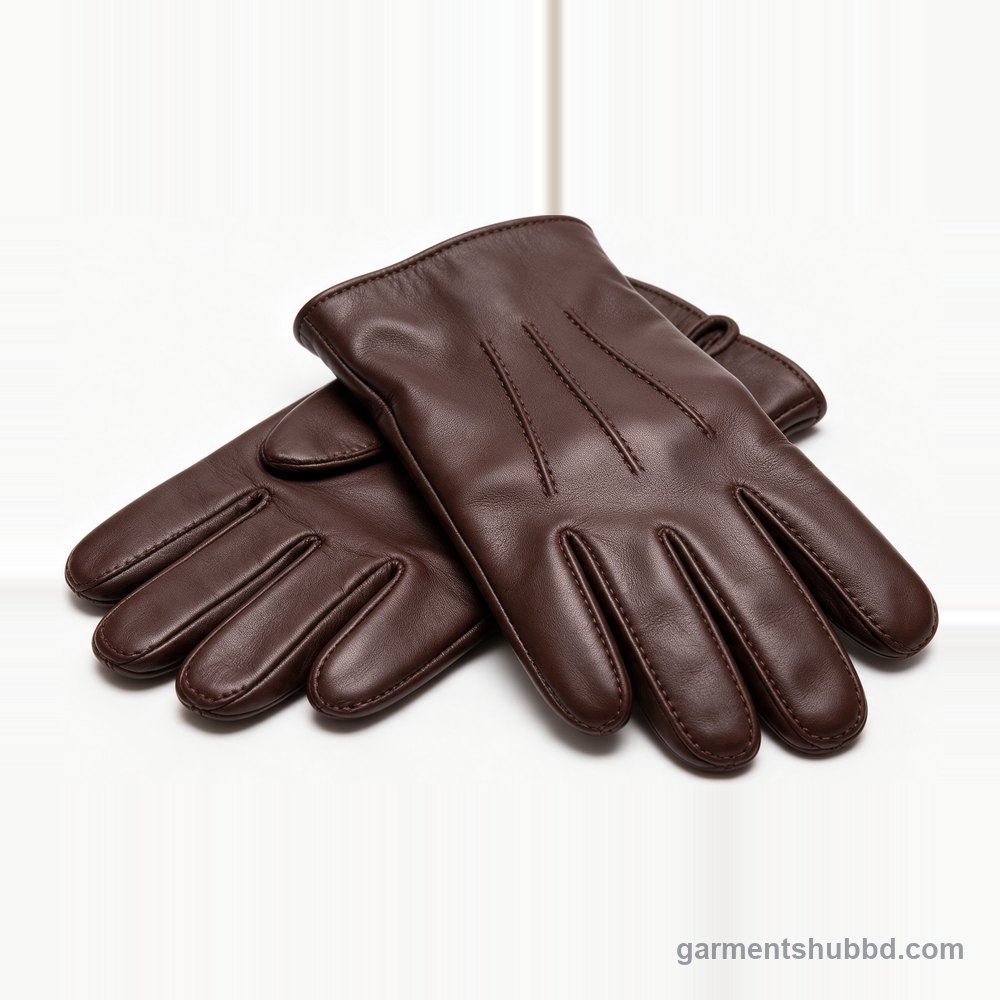
A dress glove is the slim leather glove worn with a coat in town: wrist length or longer, three lines of stitching on the back, and a lining that adds warmth without bulk. Department stores, accessory labels and gift ranges buy it for autumn and winter. For a leather dress glove manufacturer in Bangladesh, the cutter matters more than the sewing line, because the skin decides how the glove fits.
Hand gloves have no factory bench at Garments Hub BD yet, so a dress glove enquiry starts with a search. The desk looks for a unit whose cutters stretch and cut thin skins by hand, visits it with your sample pair and size chart, and replies within 5 working days with a real quote or a straight no.
Kinds of leather dress glove
Unlined lambskin gloves
The thinnest and closest fitting dress glove, usually cut from skin around 0.5 mm. Chosen for spring, evening wear and buyers who want the shape of the hand to show. With no lining, inside seam allowances must be trimmed neatly.
Silk lined gloves
A silk lining tacked inside a lamb shell adds light warmth and lets the glove slide on. Ask whether the lining is real silk or a polyester satin, as the price and the feel differ.
Cashmere lined gloves
A knitted cashmere or cashmere blend lining joined at the fingertips and cuff. The warmest dress glove and the bulkiest inside, so the leather is cut slightly larger and the fit sample is made with the lining in place.
Kid goatskin gloves
Goat leather has a tighter grain and wears better than lamb at the same thickness, with a slightly firmer feel. Chosen for a glove meant for daily use rather than for occasions.
Long evening gloves
Elbow or opera length, measured in buttons of about an inch each, counted from the base of the thumb. Usually unlined and cut from the stretchiest skins, so the glove passes over the forearm without bunching.
How to brief a leather dress glove manufacturer in Bangladesh
- Skin and thickness
- Name the animal, hair sheep lamb or kid goat, and the thickness, typically 0.5 to 0.8 mm for a dress glove. Ask for it to be gauged on cut pieces, not on the whole skin.
- Tannage and finish
- Chrome or chrome free tannage, and an aniline or lightly pigmented finish. Aniline shows the natural grain and marks easily; pigment hides marks but feels a little less supple.
- Cutting method
- Table cutting, where a cutter stretches each piece by hand against a template, gives the closest fit. Die cutting is faster and cheaper but ignores how each skin stretches.
- Seams, points and fourchettes
- Inseam for a clean turned edge, pique for a neat lapped edge, outseam for a casual look. Give the thread colour for the three back points and ask for fourchettes between the fingers.
- Lining attachment
- Name the lining fibre and weight and how it is held: tacked at each fingertip or left loose. A loose lining pulls out with the hand and is a frequent complaint.
- Sizes and half sizes
- Dress gloves are usually sized in inches of hand circumference across the knuckles, roughly 6 to 8 for women and 8 to 10 for men, often in half sizes. Send the size curve.
Tests and market rules for leather dress gloves
- REACH Annex XVII, entry 47
- Limits chromium VI in leather articles in contact with the skin to 3 mg/kg in the EU. A dress glove sits on bare skin for hours, so ask for a report per colour of finished skin.
- ISO 105-E04
- Shows whether a dyed textile holds its colour against sweat, with a grey scale grade where 5 means no change. Apply it to a silk or cashmere lining, since a warm hand sweats and a bleeding lining stains the palm.
- LWG
- The Leather Working Group audits tanneries on environmental performance, rated gold, silver, bronze or audited. If your buyer asks for it, the rating must belong to the tannery that supplied these skins.
What moves the price of a leather dress glove
- Skin grade: clean, tight lamb with few scars costs more per skin than a lower grade with marks to cut around.
- Lining: cashmere costs more than silk, and silk more than a polyester satin or a wool knit.
- Table cutting by hand takes far longer than die cutting and needs an experienced cutter.
- Length: an opera glove uses far more leather than a wrist length glove and takes longer to sew.
Lead time for leather dress gloves
Dress glove samples typically take 10 to 18 days, longer if the colour needs a fresh tannery dye lot. Bulk for dress gloves usually runs 40 to 65 days after the pre-production pair is approved in writing. A cashmere lining bought in small quantity, extra half sizes or a chromium VI test without a recent tannery report each add days. The quote confirms every date.
What we check on leather dress gloves before shipment
- Thickness on cut piecesSeveral cut pieces per colour are gauged, because a skin thicker than specified gives a stiff glove that no longer fits.
- Stretch across the handPieces are pulled by hand to confirm the stretch runs across the palm, not along the fingers, or the glove will not go on.
- Matched pairsLeft and right gloves are compared for shade and grain, since a pair cut from two skins can look mismatched in daylight.
- Points and lining tackThe three back points are checked for even spacing and skipped stitches, and the lining is pulled at each fingertip.
Questions buyers ask about leather dress gloves
Can one order mix lamb and goat dress gloves?
Usually, if each skin and colour reaches the minimum. Lamb and goat stretch differently, so each needs its own pattern adjustment and its own approved fit sample. A range in one skin throughout is simpler to grade and cheaper to sample.
How thin can dress glove leather go?
Around 0.5 mm is usual for an unlined lambskin glove; thinner skins tend to tear at the fourchettes and fingertips. Lined gloves often sit nearer 0.7 to 0.8 mm. State the figure in the specification and have it gauged at inspection.
Should the lining be silk or cashmere?
Silk keeps the glove slim and suits autumn and spring; cashmere is for real winter warmth. Cashmere takes up room inside, so the leather is cut a touch larger and the fit sample has to be approved with the lining fitted.
Do women's dress gloves need half sizes?
For a fitted women's glove, usually yes, because a whole size step is too wide on a glove with almost no ease. Each half size is another pattern set and adds cost, so many buyers launch in whole sizes and add halves on repeats.
Get a quote for leather dress gloves
Tech pack or sketch with quantities per colour. A vetted unit and a real quote, or a straight no, within 5 working days.