Lightweight down jackets, your specification
Made to your tech pack, fabric and colours by a factory matched to the order.
Private label
Your main label, care label, hangtag and polybag. Nominated trims accepted.
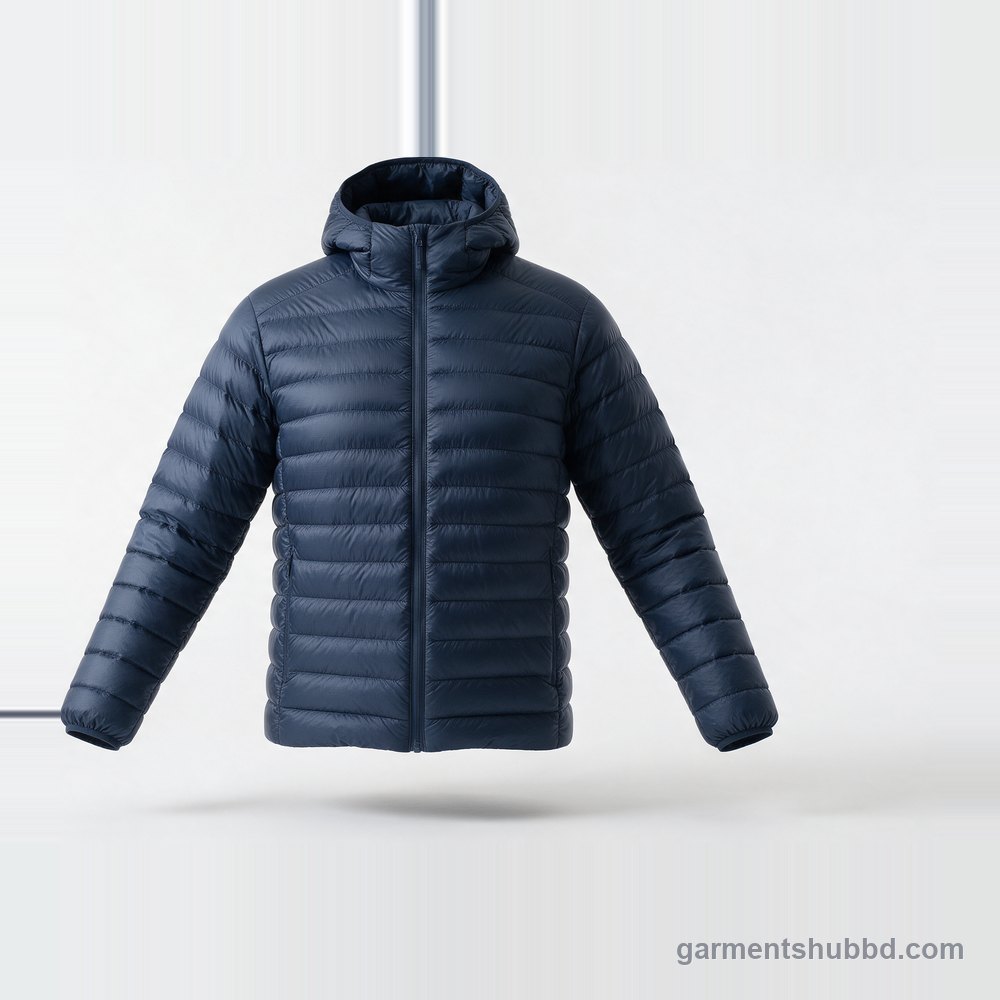
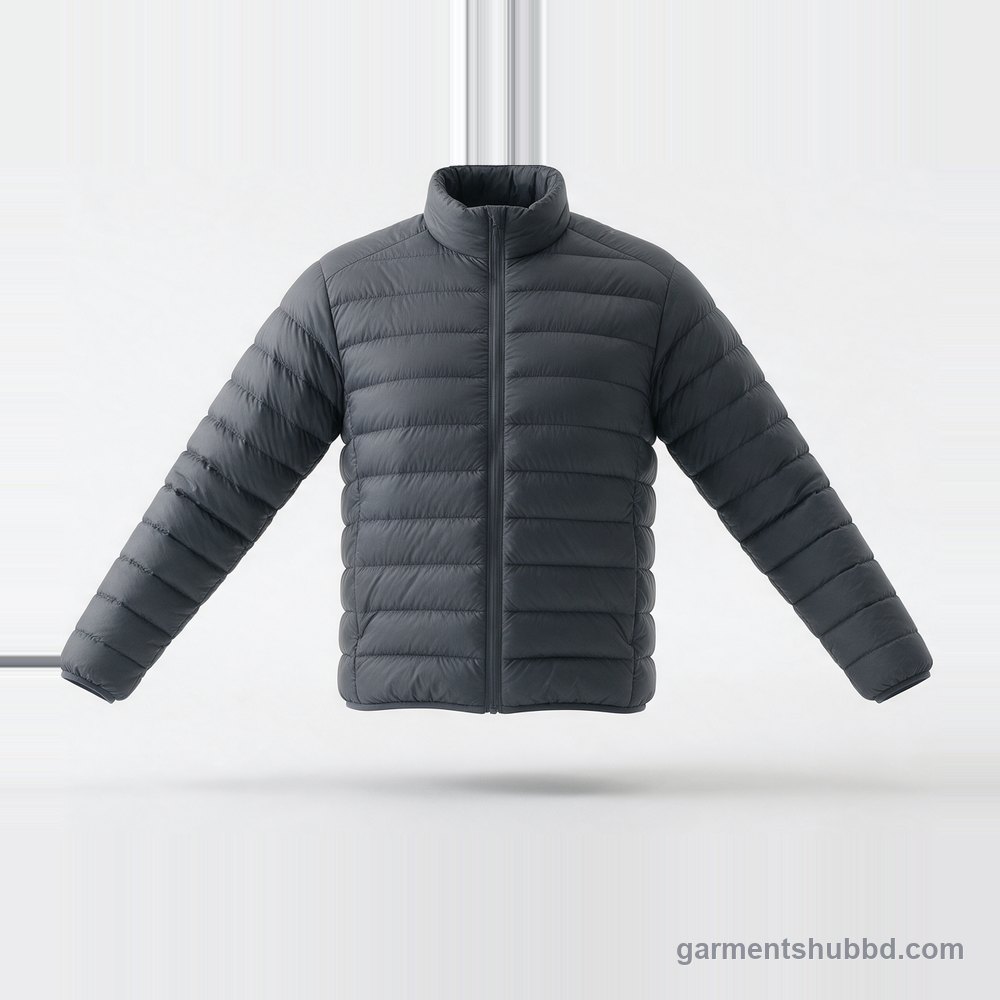
A lightweight down jacket uses a shell of 20 denier or less, sewn through baffles and a small fill, usually 40 to 80 grams in an adult medium. It is the volume item of a down range: worn alone in spring and autumn, layered under a shell in winter, and packed into its own pocket or a bag for travel. A lightweight down jacket manufacturer in Bangladesh makes lightweight and packable styles on the same line; they are one product sold under two names.
Garments Hub BD sends the enquiry to two factories on its bench and compares both quotes against the same fill power, fill weight and shell, because a cheaper jacket with less or lower grade down is not really cheaper. Ask for a fill power report on the quote form and it is built into the timeline.
Kinds of lightweight down jacket
Ultralight 7 to 10 denier
The thinnest nylon shells with 40 to 60 grams of high fill power down. Very light and compact but easy to snag; a technical and travel piece.
Everyday 15 to 20 denier
A sturdier shell with 60 to 80 grams of fill. The volume version for high street and outdoor lifestyle ranges.
Pocket packable
Packs into its own chest or hand pocket, which has a two-sided zip so the pocket turns into a pouch with a carry loop. Most packable down jackets use this build.
Stuff sack packable
Supplied with a separate drawstring sack sized to the packed jacket. Simpler than a self pocket, and the sack can carry the brand.
Bonded baffle
Baffle lines welded or glued rather than stitched, leaving no needle holes for down to escape. It needs bonding equipment and costs more.
Briefing a lightweight down jacket manufacturer in Bangladesh
- Shell denier and density
- State the denier and the thread density, often written as 380T or 400T on light nylon. Denser weaves hold down in better.
- Downproof finish
- Confirm the shell is downproof, woven dense and calendered or coated, and ask for the shell's downproof result before cutting.
- Fill weight
- Grams per jacket in the sample size, and per panel if distribution matters. A lightweight jacket usually carries 40 to 80 grams.
- Fill power and ratio
- For example 650 fill power at 90/10 down to feather. A fill power on the hangtag is a claim and needs a report behind it.
- Pack size
- Packed dimensions in centimetres and whether it packs into a pocket or a sack. The customer judges the jacket on this.
- Baffle pitch
- Spacing between stitch lines, often 6 to 10 cm. Narrow baffles stop down shifting but add stitch lines, and every line is a leak point.
Tests for lightweight down jackets
- IDFB testing regulations
- Fill power and the down to feather ratio are tested to these. Any fill power printed on the hangtag should have this report behind it.
- Downproofness test
- A filled pouch of shell fabric is rubbed or tumbled and the escaped down counted. Agree the method and pass level with the lab before bulk.
- ISO 13937
- Tear strength. A 10 to 20 denier shell tears far more easily than heavier cloth, so set a minimum for the shell fabric itself.
- ISO 4920
- Spray test for water repellency. Most light shells carry a water repellent finish, and this shows how well it sheds light rain.
What moves the price of a lightweight down jacket
- Fill power: 750 fill costs a good deal more per gram than 600 fill.
- Fill weight, since down is bought by the kilo and is the costliest material.
- Shell denier and density; finer, denser nylon costs more and sews slower.
- Packable features: a self pocket with a two-sided zip, or a separate sack.
- Bonded baffles in place of stitched ones.
- RDS certified down and the chain of custody paperwork behind it.
Lead time for lightweight down jackets
Samples take 7 to 14 days once shell and down are in hand. A lightweight down jacket order runs 30 to 60 days of bulk after PP approval. Down at a specific fill power, RDS certified down or a shell woven to order can each add sourcing days, and a fill power or downproof test on the bulk lot adds a few more.
What we check on lightweight down jackets before shipment
- Pack testSampled jackets packed into their pocket or sack, which must close easily and match the packed size in the spec.
- Leakage at stitch linesPanels rubbed and flexed along the baffle lines, looking for clusters working out through needle holes.
- Even fill per baffleEach baffle held to the light and felt by hand for empty or overfilled channels.
- Fill weightA cut sample jacket emptied and its down weighed against the grams in the spec.
Questions buyers ask about lightweight down jackets
What fill power suits a lightweight down jacket?
Usually 600 to 800. Higher fill power gives the same warmth at less weight and packs smaller, which matters most on a jacket sold as light. Below 600 you need more grams for the same loft and the jacket packs bigger.
Will down leak through a 10 denier shell?
Some will if the shell is not downproof or the baffles are sewn with a coarse needle. A dense, calendered shell, fine needles and a downproof test before bulk keep leakage low. The odd escaping cluster is normal; quills poking through are not.
Is a packable down jacket different from a lightweight one?
Usually not. Packable means the lightweight jacket is built to compress into a pocket or a sack, which adds a two-sided zip pocket or a sack to the spec. Shell, fill and baffles stay the same.
Can we print the fill power on the hangtag?
Yes, if a test report backs it. Fill power is tested to IDFB testing regulations, and many buyers retest the bulk down. For the EU, the down and feather composition on the label follows EN 12934.
Get a quote for lightweight down jackets
Tech pack or sketch with quantities per colour. A compared quote in 48 hours.