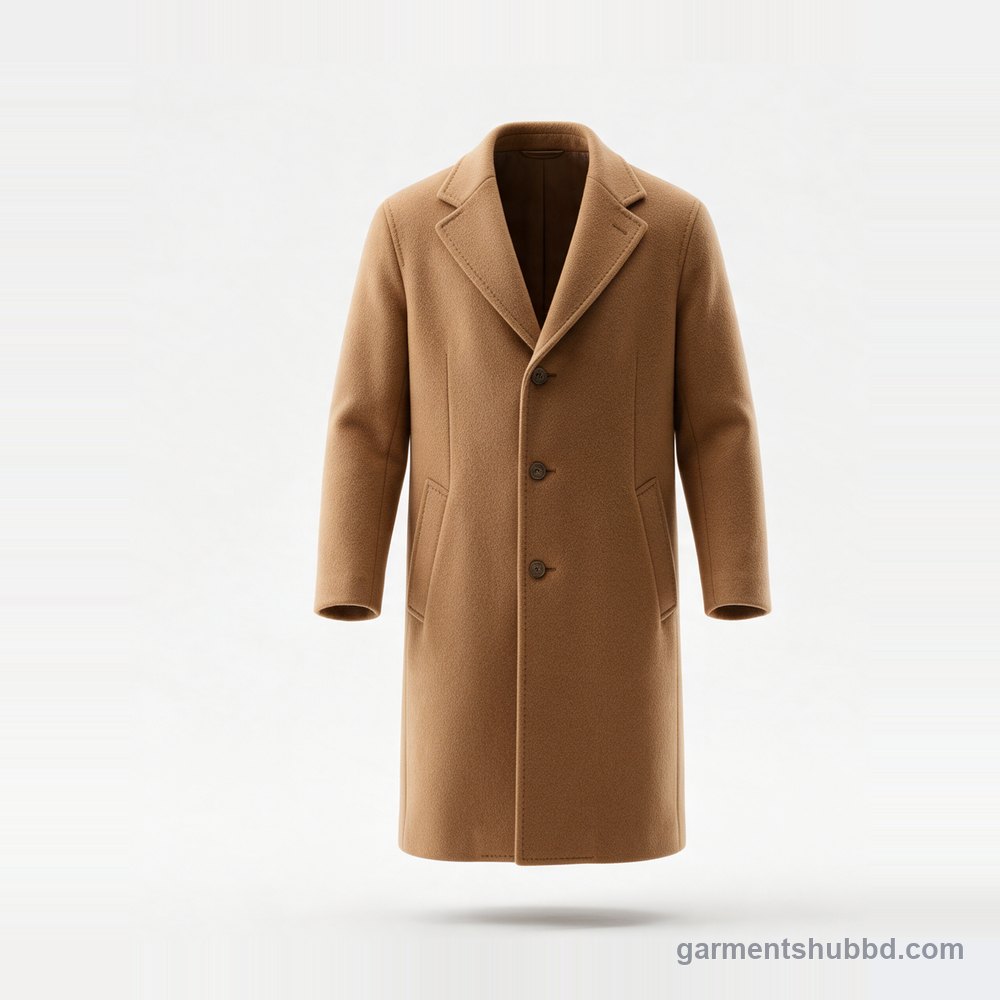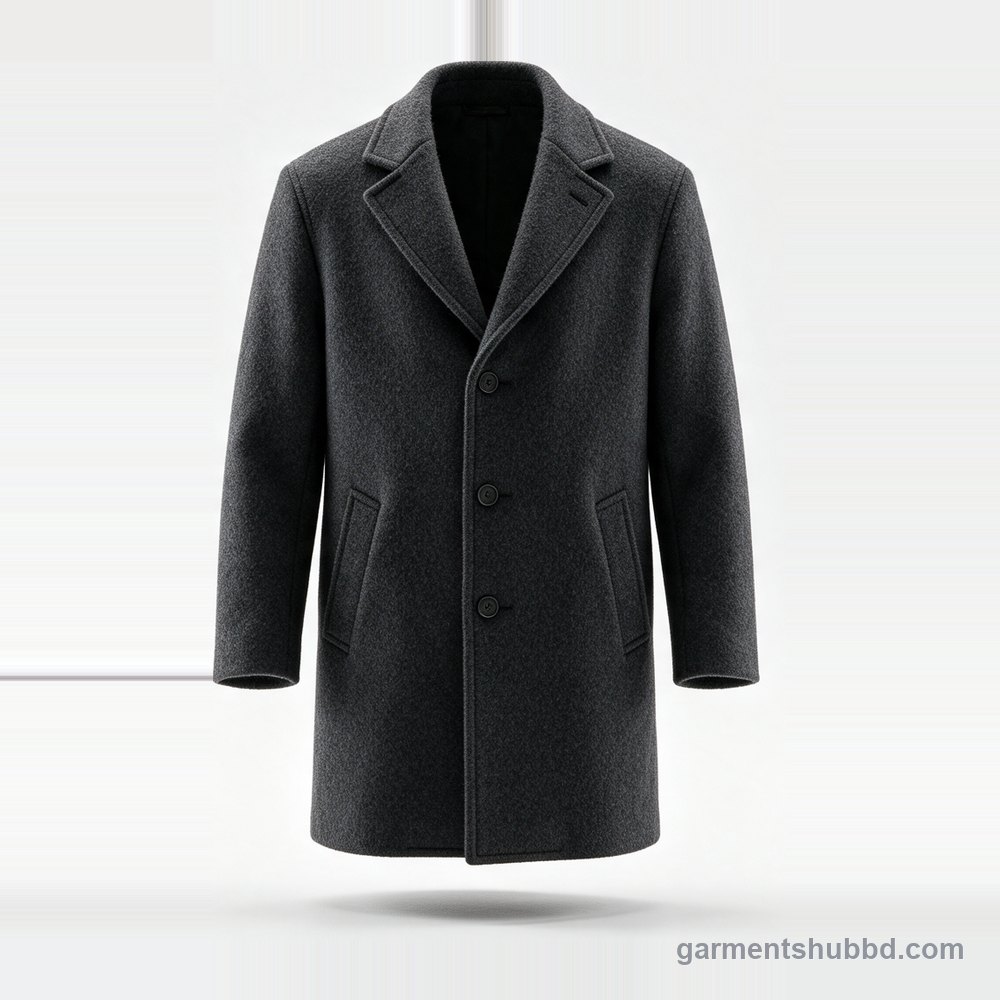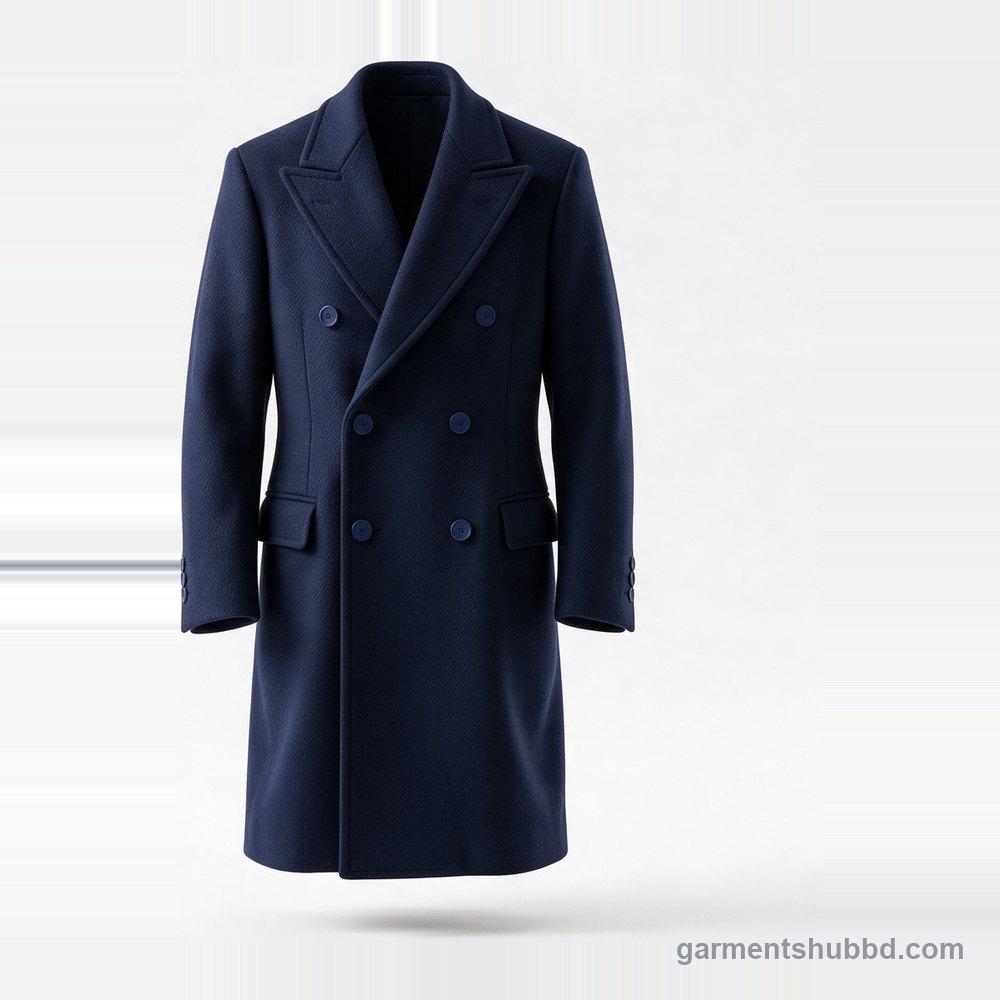
Double breasted overcoats, your specification
Made to your tech pack, fabric and colours by a factory matched to the order.
Private label
Your main label, care label, hangtag and polybag. Nominated trims accepted.
A double breasted overcoat crosses one front over the other and fastens with two columns of buttons, usually under a peak lapel. It is the formal, slightly naval coat in a winter range, cut long and often in navy, charcoal or camel. Buyers who brief a double breasted overcoat manufacturer in Bangladesh are paying for structure: the wide overlap, the firmer canvas and the button layout are what the coat is judged on, and each one costs cloth and labour.
State the canvas level on the enquiry and both factories on the bench quote the same front, so their figures compare like for like. Ask each one for the cloth consumption per size as well, because the overlap and wider facings use more cloth than a single breasted body.
Kinds of double breasted overcoat
Six on two
Six buttons in three rows, with the top pair set wider apart as decoration and two rows that fasten. The lapel rolls long to the waist, the classic city version.
Six on three
All three rows can fasten, so the lapel is shorter and the coat closes higher on the chest. It suits a colder market and a more military reading of the coat.
Four on two
Two rows of buttons on a shorter front, lighter looking and a little cheaper in buttons and buttonholes. It works on a coat cut above the knee or for a smaller frame.
Eight button greatcoat
Four rows on a long front, often with a half belt at the back and a deep collar. It uses the most cloth of any version and needs the firmest canvas.
What to tell a double breasted overcoat manufacturer in Bangladesh
- Overlap
- Give the extension from centre front to the front edge in centimetres, and whether it grades with the chest or stays fixed. Too little overlap and the coat gapes when the wearer sits.
- Button layout
- The gap between the columns and between rows on the sample size, with a grade rule for each. Rows that do not move with the waist line drift high on large sizes.
- Jigger button
- An inside button that holds the underlap in place. Without it the inner front drops and shows below the outer front at the hem, so put its position on the tech pack.
- Peak lapel
- Width at the peak, gorge height and the angle of the point. A wide peak needs a firm canvas and a felt under collar to stop the points curling up.
- Canvas
- The crossed front is one large flat panel, so a fused front that ripples is easy to see. Half canvas with a horsehair chest piece is the usual floor; full canvas suits a formal range.
- Cloth and buttons
- Usually 500 to 700 GSM in melton, twill or a heavy flannel. Name the button material, horn, corozo, resin or metal shank, and count the jigger, cuffs and spares.
Tests that matter on a double breasted overcoat
- ISO 105-X12
- Rubbing fastness, graded 1 to 5 on the grey scale. Dark navy and black melton can stain a pale scarf or shirt collar, so ask for dry and wet grades on the dyed cloth.
- REACH Annex XVII, entry 27
- Gilt or brass shank buttons resting on the wrist must not release nickel above 0.5 micrograms per square centimetre per week; ask the button supplier for a report for the EU.
- ISO 12947
- Martindale abrasion. The outer front edge and the cuffs of a crossed front take the most rubbing; a cloth with a low result shines and wears there first.
What moves the price of a double breasted overcoat
- Cloth consumption per coat, which the overlap, wider facings and peak lapel push above a single breasted body.
- Canvas level: a full canvas front with a horsehair chest piece costs more in material and hand work.
- Button count and material: six front buttons, a jigger, cuff buttons and spares, dearer in horn or metal.
- Grading the button layout across a wide size range, which adds pattern work and a sampling check.
- Extras such as a half belt at the back, a throat tab or a contrast under collar.
Lead time for double breasted overcoats
A double breasted overcoat takes longer to settle at sampling than a single breasted one, because the overlap, the peaks and the button layout are adjusted on the fit sample. Horn or metal buttons from a nominated supplier can add days, and a cloth made to order adds mill time before cutting. The quote lists each step, and 60 to 90 days from order confirmation to shipment is the usual span.
What we check on double breasted overcoats before shipment
- Underlap at the hemButtoned, the inner front stays hidden behind the outer front down to the hem, and the jigger button holds it there.
- Button columnsBoth columns run parallel, level row to row, and the same distance from centre front on every size measured.
- Peak pointsBoth peaks match in length and angle and lie flat instead of lifting away from the chest.
- Chest panelThe crossed front lies smooth after pressing, with no ripple or bubble where the canvas meets the cloth.
Questions buyers ask about double breasted overcoats
What is the difference between six on two and six on three?
Both carry six buttons. On a six on two the top pair is decorative and wider apart, two rows fasten and the lapel rolls long to the waist. On a six on three all rows can fasten, the lapel is shorter and the coat closes higher. Six on two reads more formal; six on three suits a colder or military styled range.
How much more cloth does a double breasted overcoat use?
It depends on length, size range and cloth width, so ask both factories for the marker consumption per size. The overlap, the wider facings and the peak lapel all add cloth over a single breasted coat of the same length, and a matched check adds more.
How are the buttons placed across sizes?
The rows are graded with the waist line so the fastening point stays at the natural waist on every size, while the gap between the columns grades far less than the chest, if at all. The middle size sets the layout. Ask for the smallest and largest sizes to be checked before cutting, because a layout that looks right in the middle can drift at the ends.
Can I order a double breasted overcoat with a fused front to save cost?
You can, but the crossed front is a large flat panel, and a fused front that loosens after steaming or dry cleaning shows there first. If the price has to come down, a half canvas front with a lighter chest piece usually keeps the look for less than full canvas. Ask for both options on the quote.
Get a quote for double breasted overcoats
Tech pack or sketch with quantities per colour. A compared quote in 48 hours.