Leather backpacks, your specification
Made to your tech pack, fabric and colours by a factory matched to the order.
Private label
Your main label, care label, hangtag and polybag. Nominated trims accepted.
A leather backpack hangs its load from two straps that pull on two small points at the top of the back panel, and that is where a weak make gives way first. Buyers range from heritage menswear labels to travel shops and corporate gift programmes. Choosing a leather backpack manufacturer in Bangladesh starts with the anchors, the back panel and the hardware, and only then the look.
There is no backpack unit vetted by Garments Hub BD today. For your enquiry the desk looks for leather goods units already sewing straps and padded panels, walks their floors with your drawing, and comes back inside 5 working days with a real quote from one of them or a straight no. Test reports your market needs are built into the timeline from the quote form.
Kinds of leather backpack
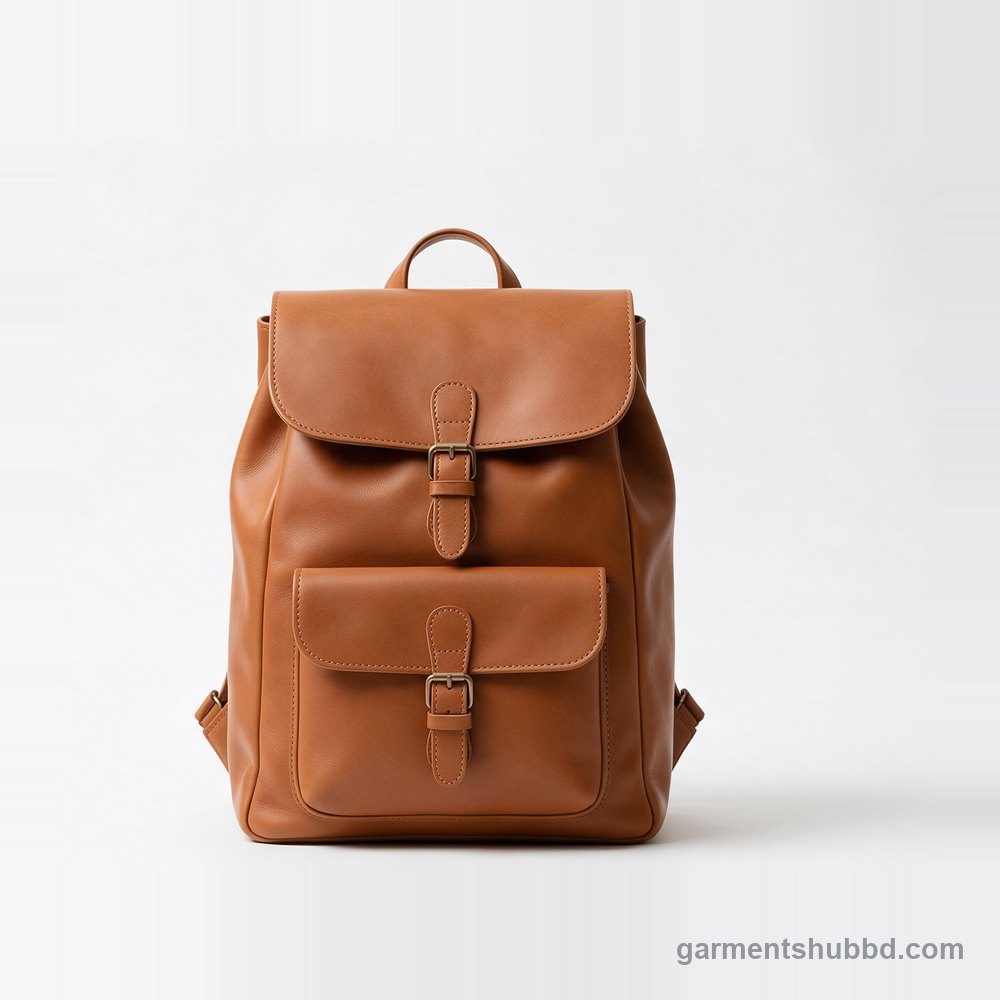
Flap rucksack with a drawstring
A cinched neck under a buckled flap, the heritage shape. Two or three buckles and straps on the front make it heavy on hardware, and the flap needs a firm hide to lie flat.
Zip top daypack
A zip runs round the top panel and opens the bag wide. This is the commuter backpack, usually with a padded back and a sleeve inside for a tablet or small laptop.
Roll top backpack
The top folds down two or three times and closes with a strap and buckle. It needs a softer hide that rolls without cracking, and it has no main zip to fail.
Mini fashion backpack
A small body on thin straps, often with a clip that turns it into a shoulder bag. Lighter leather, usually 1.0 to 1.2 mm, and the finish counts for more than capacity.
How to specify a leather backpack
- Strap anchors
- Patch size and material, double leather or webbing, and the fixing: rivets, a bar tack or both. The two anchors at the top carry the whole packed weight.
- Shoulder straps
- Width, usually 30 to 50 mm on unpadded leather straps, any padding, and the adjustment range in millimetres. Name a metal slider or a buckle with holes.
- Back panel
- Leather over foam, or air mesh over closed cell foam usually 5 to 10 mm thick. Mesh lets air through; leather looks cleaner and runs warmer.
- Closure
- A flap with buckles, tuck locks or magnetic snaps; a zip with its size and pullers; or a drawstring through metal eyelets. Each choice changes the hardware list.
- Size and largest item
- Height, width and depth in millimetres, a target volume in litres, and the largest thing it must take, such as a laptop or an A4 folder, with its size.
- Empty weight
- Leather backpacks often weigh over 1 kg before anything goes in. Set a maximum in grams so thickness and hardware are chosen to suit it.
Tests to ask a leather backpack manufacturer in Bangladesh for
- ISO 12947
- Martindale abrasion for the air mesh or textile covering on the back panel, which rubs against clothing with every step. Ask how many cycles the mesh reached.
- REACH Annex XVII, entry 47
- Backpack straps sit on bare shoulders in summer, which puts them under the 3 mg/kg chromium VI limit for leather touching skin. An EU buyer will want the hide lot tested.
- amfori BSCI
- EU backpack buyers often ask for this social audit of the unit. Raise it at the enquiry, because requiring it narrows which units can be shortlisted.
What moves the price of a leather backpack
- Component count: straps, anchors, back panel, pockets and flap make a backpack one of the more heavily pieced leather bags.
- Hardware: each buckle, slider, D ring and rivet is a part to buy, plate and fix, and solid brass costs more than zinc alloy.
- A padded back with foam and mesh adds materials and a separate sub-assembly.
- Inside organisation: a padded sleeve, zip pockets and pen loops each add lining cuts and sewing time.
- Double layer straps with painted edges take more leather and finishing than single layer straps.
Lead time for leather backpacks
Backpack samples usually take 14 to 21 days, and bulk 45 to 75 days from written PP approval. Custom cast buckles or sliders add days for the mould and plating, and a padded back sometimes needs a second proto to get the strap angle right on a body. Dates are confirmed in the quote.
What we check on leather backpacks before shipment
- Anchor loadBackpack loaded with weight and hung from one strap; rivets, bar tacks and the patch behind them inspected afterwards for any pull.
- Strap length and slidersBoth straps let out to full length and measured; sliders hold under load without creeping.
- Back paddingFoam laid evenly, with no lumps, folds or gaps that can be felt through the leather or mesh.
- Flap and bucklesThe flap closes square, buckle tongues meet their holes, and tuck locks line up on every piece.
Questions buyers ask about leather backpacks
How much weight should a leather backpack be built to carry?
Set a working load in kilograms in the specification, based on what your customer carries daily: a laptop, a water bottle and a jacket, for example. Anchors and straps are then built and checked for that load. Without a figure, the unit builds to its own habit.
Bar tack or rivet at the strap anchor?
Both, if the bag will carry a laptop. The rivet holds the patch through the leather, and the bar tack stops the stitching around it from unpicking under load. A rivet alone can tear through a thin hide, and a bar tack alone can work loose on a heavy bag.
Can a leather backpack have a breathable back?
Yes. Air mesh over closed cell foam lets air move behind the back and is the usual choice for commuters. The trade is the look, because mesh reads sporty. A leather covered back with channels between foam pads is a middle route.
Can one backpack design be offered in two leathers?
Yes, as two styles on one pattern. A softer hide may need a stiffer interlining in the flap or straps to match the shape of the firmer one, so each leather gets its own sample, and the prices can differ.
Get a quote for leather backpacks
Tech pack or sketch with quantities per colour. A vetted unit and a real quote, or a straight no, within 5 working days.