Long leather coats, your specification
Made to your tech pack, fabric and colours by a factory matched to the order.
Private label
Your main label, care label, hangtag and polybag. Nominated trims accepted.
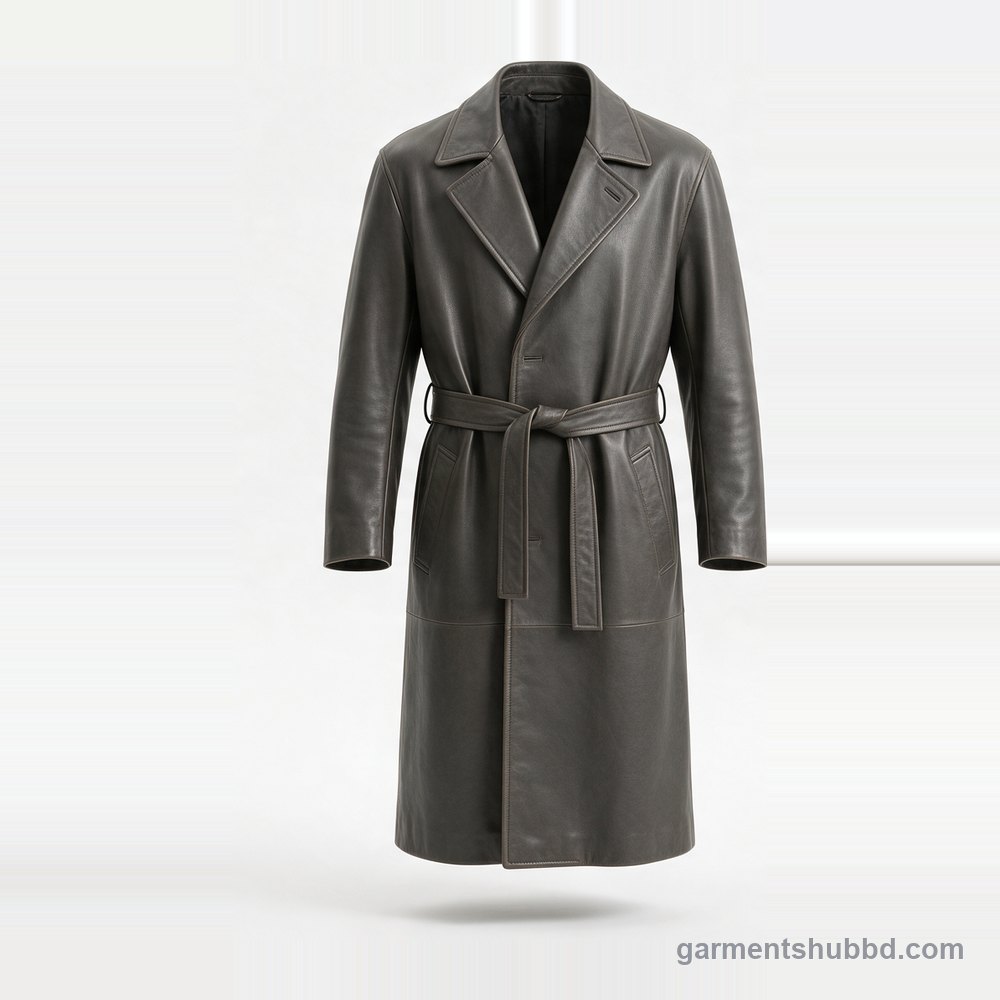
A long leather coat reaches the knee or below: a trench, an overcoat or a duster. Brands sell it as the high ticket piece of a leather range, in smaller numbers than jackets. A long leather coat manufacturer in Bangladesh has to find panels long and clean enough for a front that runs past a metre, which means a better hide grade, more waste around marks, and a price well above a short jacket for that reason alone.
Garments Hub BD has no leather garment unit arranged beforehand. For a long coat the desk looks for a unit that already cuts full length panels and lines heavy garments, vets and visits it, and replies within 5 working days with a real quote or a straight no. Your coat pattern stays with that unit and your order.
Kinds of long leather coat
Leather trench
Double breasted, with a storm flap, epaulettes, a buckled belt and a back vent. More panels and hardware than the other long coats, and buttons and belt that must carry real weight.
Single breasted overcoat
A clean front with a notch or stand collar and concealed buttons. Few seams means every panel is on show, so the hide grade has to be higher.
Duster or maxi coat
Mid calf to ankle length, often with a deep back vent. The front panels outrun the length of most sheep skins, so expect a horizontal join or a switch to a larger hide.
Belted wrap coat
No buttons, a wide self belt and a shawl collar, mostly for womenswear. Soft sheep drapes well here, but the belt needs a backing so it does not stretch or roll.
What to give a long leather coat manufacturer in Bangladesh
- Length and panel plan
- Back length in centimetres and where any horizontal joins may fall. Sheep and goat skins are usually around 5 to 10 square feet, too short for a one piece front on many long coats.
- Hide grade
- The surface marks you accept, agreed on a hide sample. Long clean panels push the grade up, and the grade decides how much of each hide is wasted.
- Leather and weight
- Sheep or goat at around 0.8 to 1.0 mm keeps a long coat wearable all day; cowhide of 1.2 mm makes a heavy coat that drags from the shoulders.
- Lining
- A full lining in viscose or polyester twill, with a free-hanging hem held at the side seams by thread tacks so lining and leather move apart. Add a warm interlining only if the market needs it.
- Front structure
- Leather does not take hot fusing well, so ask how the front and collar are stiffened: sew-in canvas, a low temperature fusible or a leather facing.
- Closures and belt
- Button size and material, a small stay button behind each to spread the load, and the belt buckle with its plating.
Tests and certificates for long leather coats
- ISO 13936
- Seam slippage in woven fabric. A long coat lining carries strain at the back vent and down the side seams, so ask for the lining fabric's result before it is cut.
- REACH Annex XVII, entry 47 (chromium VI)
- Coat leather touching skin must stay below 3 mg/kg of chromium VI. One long coat often uses hides from more than one tannery batch, so ask that the test covers each batch.
- REACH Annex XVII, entry 43 (azo dyes)
- Azo dyes releasing listed amines above 30 mg/kg are restricted. Dark dyed coat leathers and a dyed lining both fall under it, so the report should name both materials.
- LWG
- A long coat needs larger hides of a higher grade, so confirm that a tannery rated gold, silver, bronze or audited by the Leather Working Group can supply that grade in your colour.
What moves the price of a long leather coat
- Hide grade: long clean panels push the grade up and the usable share of each hide down.
- Length: a duster takes far more leather than a knee length coat of the same size.
- A one piece front costs more in leather than a front with a horizontal join.
- Lining length and fabric, plus any warm interlining for cold markets.
- Buttons, belt and epaulettes on a trench, against a plain concealed front.
- Shipping on hangers against folded cartons, which changes freight per coat.
Lead time for long leather coats
A long leather coat sample usually takes 14 to 21 days, and bulk 45 to 75 days after the pre-production sample is approved. Gathering enough hides of one grade and shade for long panels can add days before cutting starts, as can a colour dyed to order or a lab test per hide batch. Long coat orders tend to sit toward the end of that range; the quote gives your dates.
What we check on long leather coats before shipment
- Hem levelEach sampled coat hung and its hem measured from the floor at front, side and back; the front edges must not drop below the back.
- Shade across long panelsFront, back and sleeve panels compared side by side in daylight; a shade break down a one metre front shows at once.
- Lining hangThe lining hem hangs free inside the leather hem, the side tacks hold, and nothing pulls at the back vent.
- Buttons and hanging loopEach button pulled by hand against its stay button, and the hanging loop loaded with the full weight of the coat.
Questions buyers ask about long leather coats
Why does a long leather coat cost so much more than a jacket?
Two reasons beyond length. The panels must be long and clean, so the unit buys a higher hide grade and discards more of each hide around marks. The coat also takes more lining, more hand finishing and closer shade matching than a jacket.
Can a long coat be cut in sheep without a seam across the front?
Sometimes. A large sheep skin can give a one piece front on a knee length coat in smaller sizes, but larger sizes and dusters usually need a join or a bigger hide. Ask the unit to show its panel plan on the hide sample before you approve the pattern.
How heavy will a long leather coat be?
It depends on leather and length. Sheep or goat at around 0.8 to 1.0 mm keeps a knee length coat comfortable for a day; cowhide at the same length is clearly heavier and pulls at the shoulders. Ask for the fit sample's weight and judge it on a person, not a hanger.
Should long leather coats ship hanging or folded?
Hanging avoids fold marks on long panels and arrives ready for the rail, but takes more carton space. Folded packing with tissue at each fold costs less to ship, and fold marks in soft leather usually relax on a hanger within days.
Get a quote for long leather coats
Tech pack or sketch with quantities per colour. A vetted unit and a real quote, or a straight no, within 5 working days.