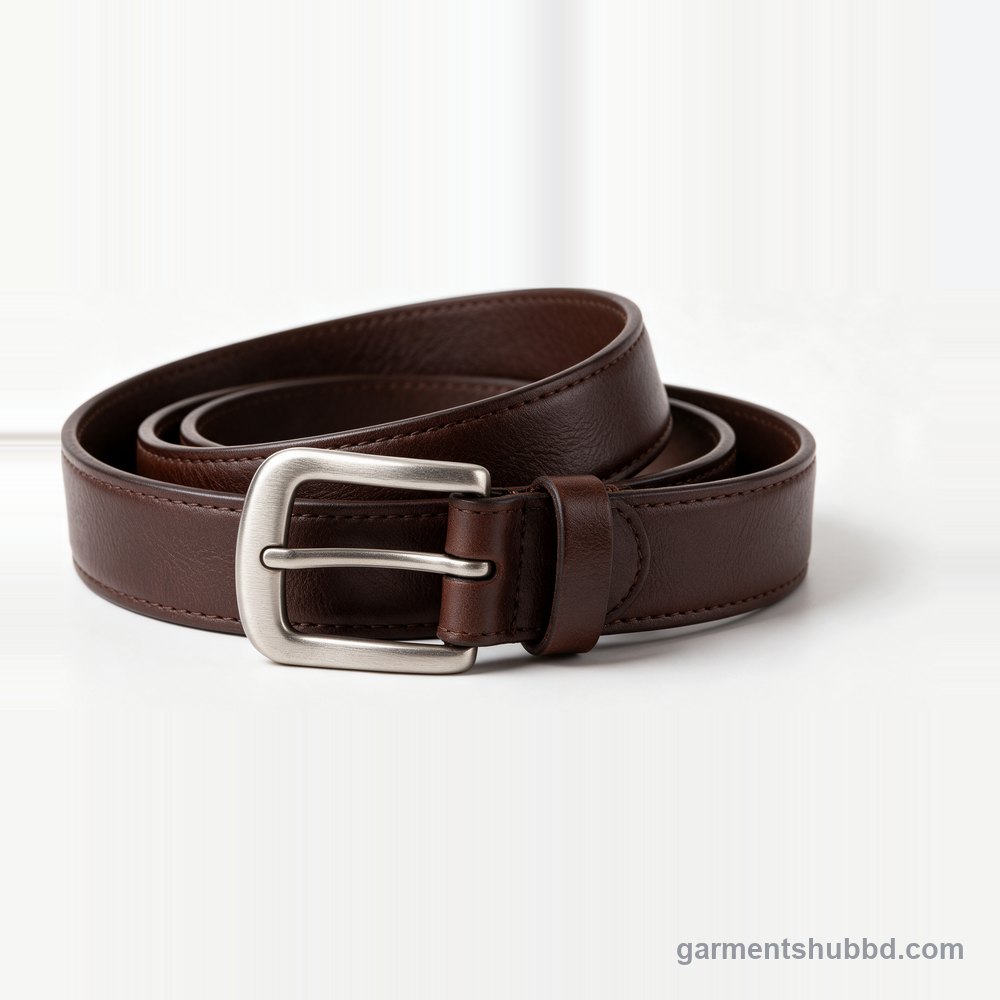
Reversible leather belts, your specification
Made to your tech pack, fabric and colours by a factory matched to the order.
Private label
Your main label, care label, hangtag and polybag. Nominated trims accepted.
A reversible belt has two show faces, typically black on one side and brown on the other, bonded into one strap and held by a buckle that turns to show either face. Menswear and travel retail ranges buy it as a two-in-one belt that saves space in a suitcase. A reversible leather belt manufacturer in Bangladesh has to get three things right: the glue line, the edges that hide it, and the turning mechanism.
Garments Hub BD has no belt unit fixed in advance. For a reversible belt the desk finds a unit that already bonds and edges two-layer straps, vets and visits it, and answers within 5 working days with a real quote or a straight no.
Kinds of reversible leather belt
Black and brown smooth reversible
Two smooth full grain leathers, the classic pairing for suits and smart trousers. Both faces must be clean, so both leathers need the grade normally kept for the show side only.
Smooth and textured reversible
One smooth face and one embossed or milled face, often in the same colour. A second texture gives a second look without a second colour, and the textured side hides marks.
Swivel pin buckle reversible
A pin buckle on a pivot that turns half a circle. Holes are punched through both leathers, so each hole wall must be sealed to hide the glue line.
Clamp buckle reversible
No holes. A plate buckle clamps the strap with teeth or a bar, and the wearer trims the strap to length. Neat on both faces, but the clamp must grip two different finishes.
How to brief a reversible leather belt manufacturer in Bangladesh
- The two leathers
- Each face named separately: animal, finish and thickness, often 1.5 to 1.9 mm each. Leathers of different firmness pull against each other and make the strap curl.
- Adhesive and curing
- Water based or solvent based contact adhesive on both buffed flesh sides, the pressing method, and the rest before cutting, commonly overnight or longer.
- Edge build
- Glued only, or glued and stitched close to the edge, then painted. Stitching through both layers is the second defence if the bond weakens.
- Buckle mechanism
- Swivel or clamp, the pivot design, the finish on the buckle's back as well as its front, and the plating.
- Total thickness
- Typically 3.0 to 3.8 mm for both layers together. Thicker straps turn poorly in a swivel buckle; thinner ones feel flimsy.
- Hole walls
- Hole size and spacing, and how the walls are coloured or sealed, since a raw hole shows the glue line between faces.
Tests and certificates for reversible leather belts
- REACH Annex XVII, entry 47 (chromium VI)
- A reversible strap carries two leathers, often from two tanneries, and each face touching skin must stay below 3 mg/kg of chromium VI. Ask for a separate report per face.
- ZDHC MRSL
- A list of chemicals banned from intentional use in facilities that process leather and trims; it covers the unit and its chemical suppliers, not the finished belt. Ask whether the adhesive and edge paint in the bonding room conform.
- REACH Annex XVII, entry 27 (nickel release)
- On a swivel buckle both faces of the frame can rest on the wearer, and nickel release from such parts is capped at 0.5 micrograms per square centimetre per week. Test the whole buckle, pivot included.
What moves the price of a reversible leather belt
- Two show grade leathers instead of one show face over a cheaper backing.
- Bonding labour and the curing time before straps can be cut and edged.
- Edges glued and stitched through both faces, against edges that are glued only.
- The swivel or clamp mechanism, which costs more than a fixed pin buckle.
- Edge paint coats, since a two-layer edge needs more filling to hide the join.
Lead time for reversible leather belts
Samples for a reversible leather belt usually take 10 to 18 days, and bulk 40 to 65 days after pre-production approval. Bonded straps rest before cutting, and a peel and heat check on the first bulk straps adds days. Both leathers, often from two tanneries, must arrive before bonding starts. Your quote confirms the dates for both faces and the buckle.
What we check on reversible leather belts before shipment
- Peel at the tip and holesLayers worked apart by hand at the tip and at a hole on sampled belts; no lifting and no open glue line.
- Swivel actionThe buckle turned face to face many times; it turns firmly, holds position, and the pivot does not loosen.
- CurlBelts laid flat on a table both ways up; the strap stays flat with no cupping or twist along its length.
- Both facesEach face inspected as a show face for scratches, shade and finish, to the same grade on both sides.
Questions buyers ask about reversible leather belts
Glued only or glued and stitched: which lasts longer?
Glued and stitched. The stitch line holds the layers together if heat or flexing weakens the adhesive, and it stops an edge from opening at the tip. A glued-only edge looks cleaner and can last when the bonding is done well, but a stitched edge gives the belt a second line of defence.
Will the bond survive a hot container?
It should, if the adhesive suits the heat and the straps cured properly before cutting. Containers crossing the tropics can stay hot for weeks. Ask the unit to keep sample straps in a warm room or oven for a day and then peel them, before bulk bonding begins.
Can each face be a different leather?
Yes. Smooth with embossed, calf with suede, or two colours of one leather all work. Pair leathers of similar firmness and stretch: a soft suede bonded to a firm calf curls toward the firmer side. A suede face also needs a rub check, because it sheds colour.
Can a reversible belt be cut to length by the wearer?
Only with a clamp buckle. The strap ships long, the wearer trims it at the buckle end, and the clamp grips the cut end inside the frame, so the glue line stays hidden. Swivel pin buckle reversibles come in fixed sizes with punched holes.
Get a quote for reversible leather belts
Tech pack or sketch with quantities per colour. A vetted unit and a real quote, or a straight no, within 5 working days.