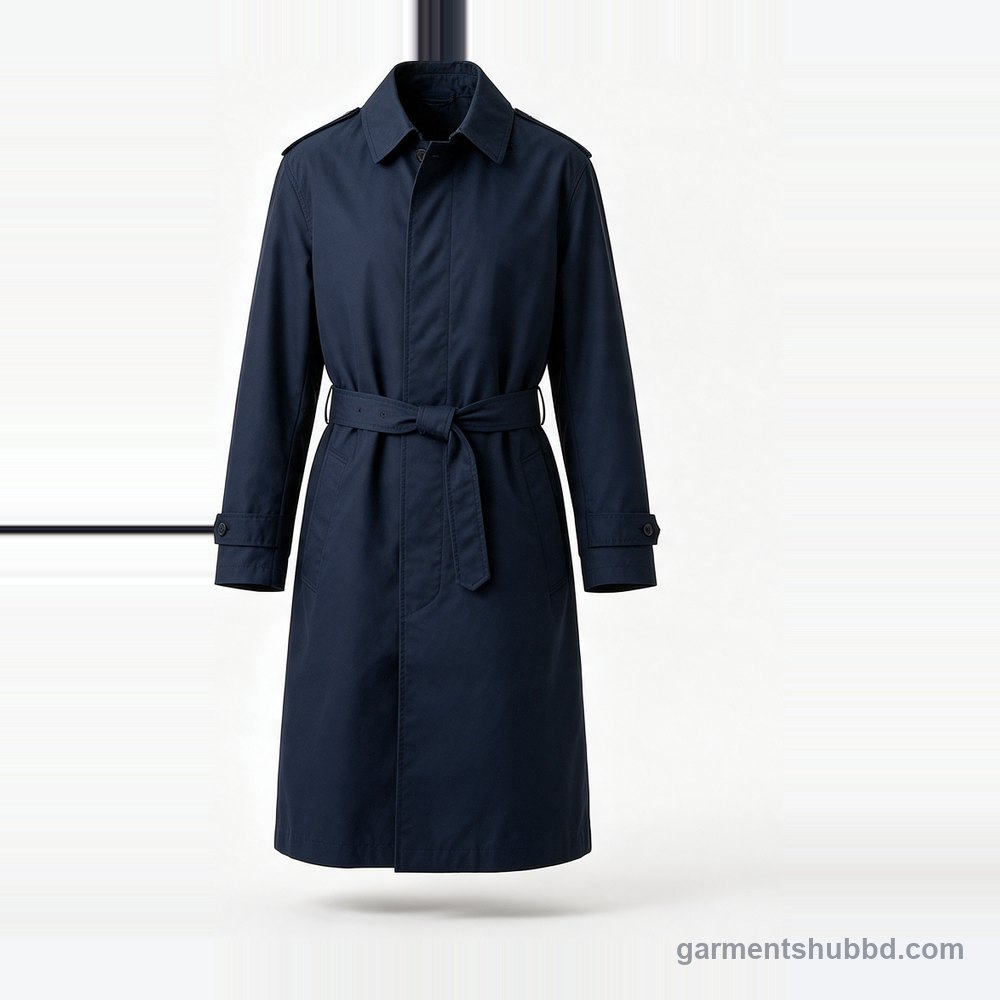
Single breasted trench coats, your specification
Made to your tech pack, fabric and colours by a factory matched to the order.
Private label
Your main label, care label, hangtag and polybag. Nominated trims accepted.
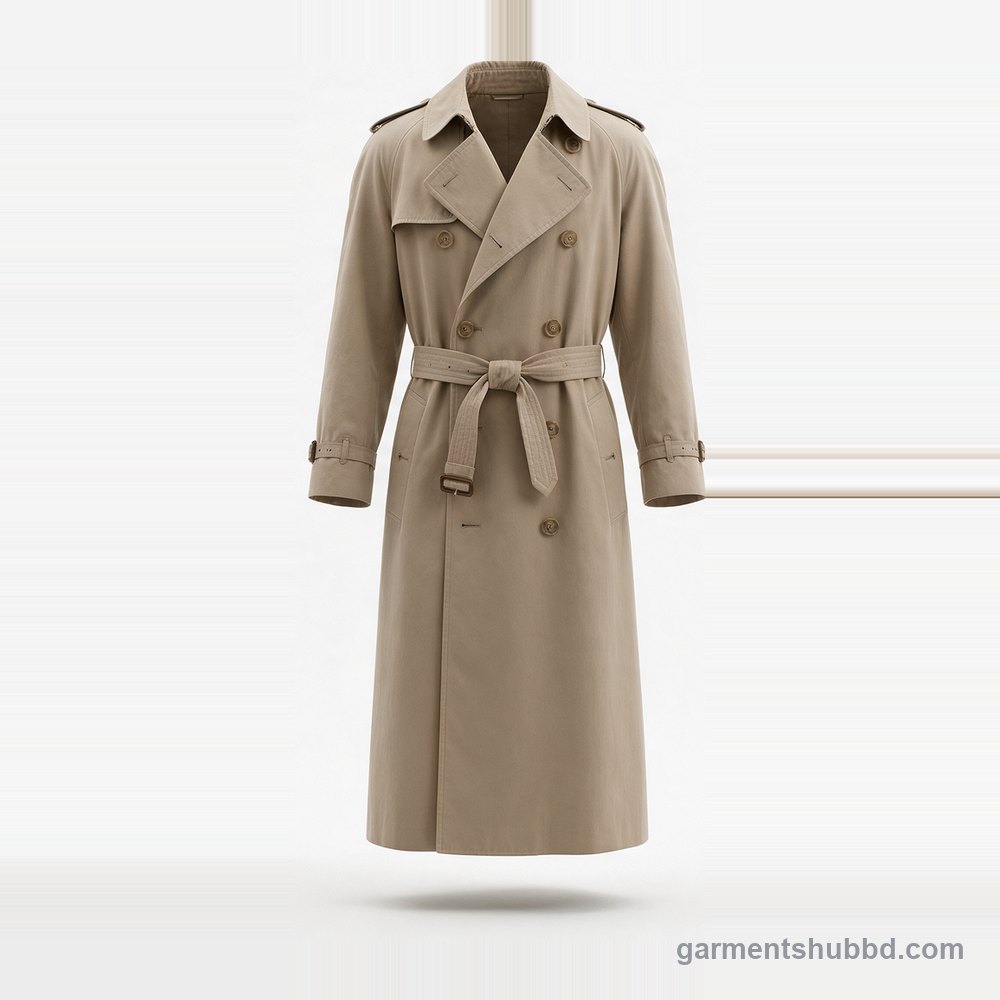
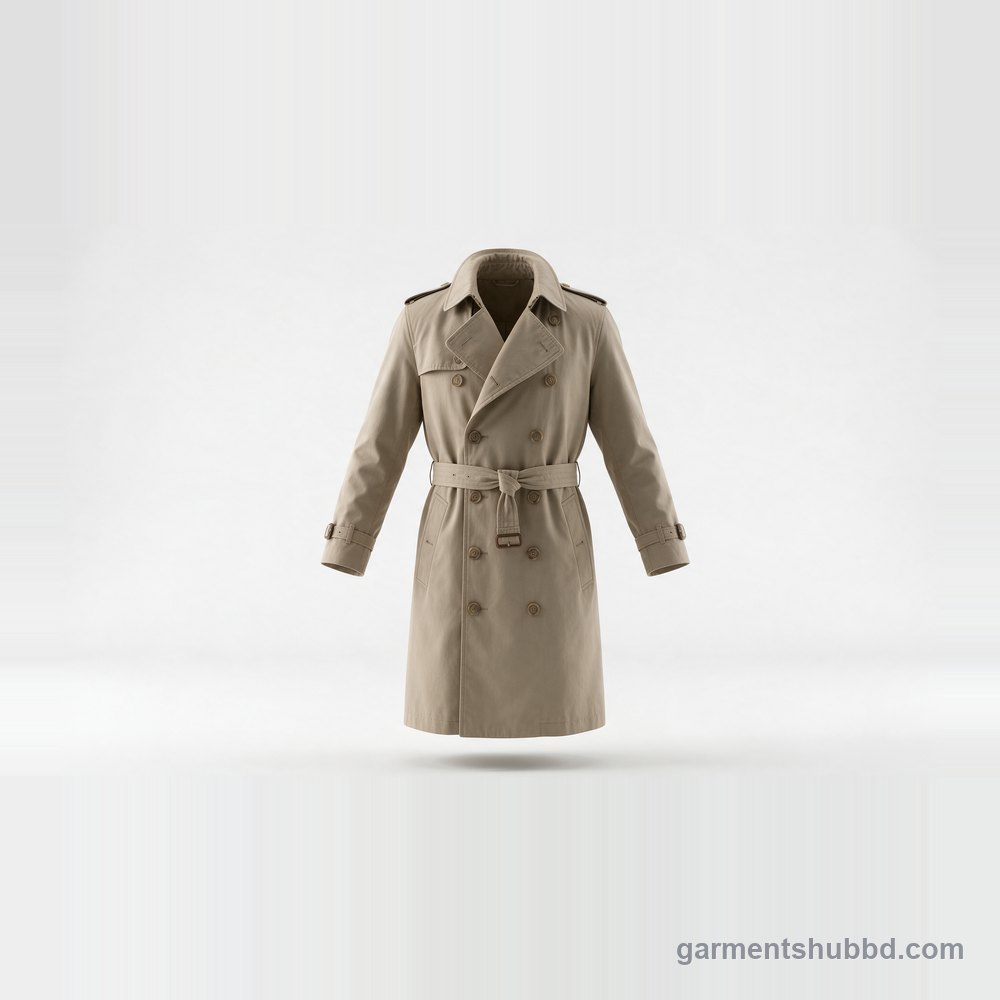
A single breasted trench coat has one row of buttons, hidden under a fly or showing on the edge, a collar that turns up, a belt and a lighter set of details than the full trench. It is cheaper to make, easier to wear open and the style most ranges sell in the largest numbers. A single breasted trench coat manufacturer in Bangladesh is usually asked for it in a washable cotton or poly cotton, for a broad customer.
As the volume coat, it is usually decided on cloth price, wash performance and line speed rather than hand work. Send the target price and the retail market with the enquiry, and both factories can propose a cloth that meets them, set side by side so the trade between cost and washability is clear.
Kinds of single breasted trench coat
Fly front trench
Buttons under a concealed placket give a smooth front that suits a minimal range. Only the collar button and the belt show.
Exposed button trench
Four or five buttons on the front edge. A little more casual, quicker to sew than a fly placket and easy to wear open.
Stripped back raglan trench
Raglan sleeves, welt pockets, belt and back vent, with the epaulettes and sleeve straps dropped. The simplest build in a range and the fastest on a line.
Washable trench
Cut in a cloth whose repellent finish survives home washing, with every trim chosen to go in a machine. For a broad market that will not dry clean a coat.
How to specify a single breasted trench coat
- Front
- Fly front or exposed buttons, the button count, usually four or five, and the top button height. A fly front needs a placket and a row of concealed buttonholes.
- Details kept and dropped
- List each trench detail as kept or dropped: gun flap, storm flap, epaulettes, sleeve straps, throat latch. The usual version keeps the belt and drops the gun flap.
- Pockets
- Slanted welt pockets with the pocket bag cloth and depth. Through pockets that reach a trouser pocket add a slit and a facing.
- Cloth and care
- Say if the coat is sold as washable. If so, the cloth and finish must hold after home washing and the lining must shrink at the same rate as the shell.
- Belt
- Self belt with a buckle, or a tie belt, with the width, the length for the largest size and the number of keepers.
- Size chart
- The full chart in centimetres with the grade rule for body length and sleeve, since a volume coat usually runs a wide size range.
Tests for a single breasted trench coat
- ISO 5077 with ISO 6330
- Dimensional change in washing. A washable trench must keep its length and sleeve after home laundering; have shell and lining tested together so they do not move apart.
- AATCC 150
- The US method for dimensional change of garments in home laundering. Use it on the finished coat for a US buyer, since seams, fusing and lining all move.
- ISO 105-C06
- Washing fastness, colour change and staining. Stone, khaki and navy are the usual trench shades; a navy shell must not mark its own pale lining in the wash.
What moves the price of a single breasted trench coat
- Detail count: each trench detail dropped, from gun flap to sleeve straps, takes sewing minutes out.
- Front build: exposed buttons are quicker than a fly placket with concealed buttonholes.
- Cloth: poly cotton twill usually costs less than cotton gabardine and shrinks less in the wash.
- Washability: a finish and trims that survive home washing cost more than a dry clean only build.
- Lining: half lined or unlined bodies are common on volume coats and save cloth and sewing.
Lead time for single breasted trench coats
This is usually the quickest trench to bring to bulk: fewer parts mean a shorter fit round and a faster line. Time goes up when the coat is sold as washable, because shell and lining need a wash test before bulk approval, and when the cloth is dyed to a new shade. The quote names each extra step, and order confirmation to shipment typically runs 60 to 90 days.
What we check on single breasted trench coats before shipment
- Fly placketThe placket lies flat over the buttons with no drag lines, and the concealed buttonholes are cut clean.
- Wash appearanceA bulk coat is washed and checked for puckered seams, lining dropping below the hem and colour change.
- Belt and keepersThe belt runs freely through keepers sewn level at the waist on every size checked.
- Front lengthBoth fronts finish at the same length when buttoned, with no step at the bottom edge.
Questions buyers ask about single breasted trench coats
Can a single breasted trench coat be machine washable?
Yes, if the cloth, finish, lining, interlining and trims are all chosen for it. Poly cotton twill with a durable repellent finish and a polyester lining is the usual build. Test dimensional change on the finished coat, and put washing instructions on the care label only after the test passes.
Fly front or exposed buttons: which costs less?
Exposed buttons cost less: they sit on the front edge with ordinary buttonholes. A fly front adds a placket piece, a row of concealed buttonholes behind it and extra pressing to keep it flat. The fly gives a cleaner look for a minimal range, so price both and decide on the look.
Which trench details stay on a single breasted coat?
Usually the belt, the back vent and often the epaulettes. The gun flap is usually dropped, and the sleeve straps and storm flap are optional. The belt matters most, because it is what makes the coat read as a trench from across a shop floor.
What shrinkage is acceptable on a washable trench?
Buyers typically set a limit within 3 percent on length and width after the agreed number of washes, tested to ISO 5077 or AATCC 150. Test shell and lining together, because a lining that shrinks more than the shell pulls the hem up and shows at the vent.
Get a quote for single breasted trench coats
Tech pack or sketch with quantities per colour. A compared quote in 48 hours.