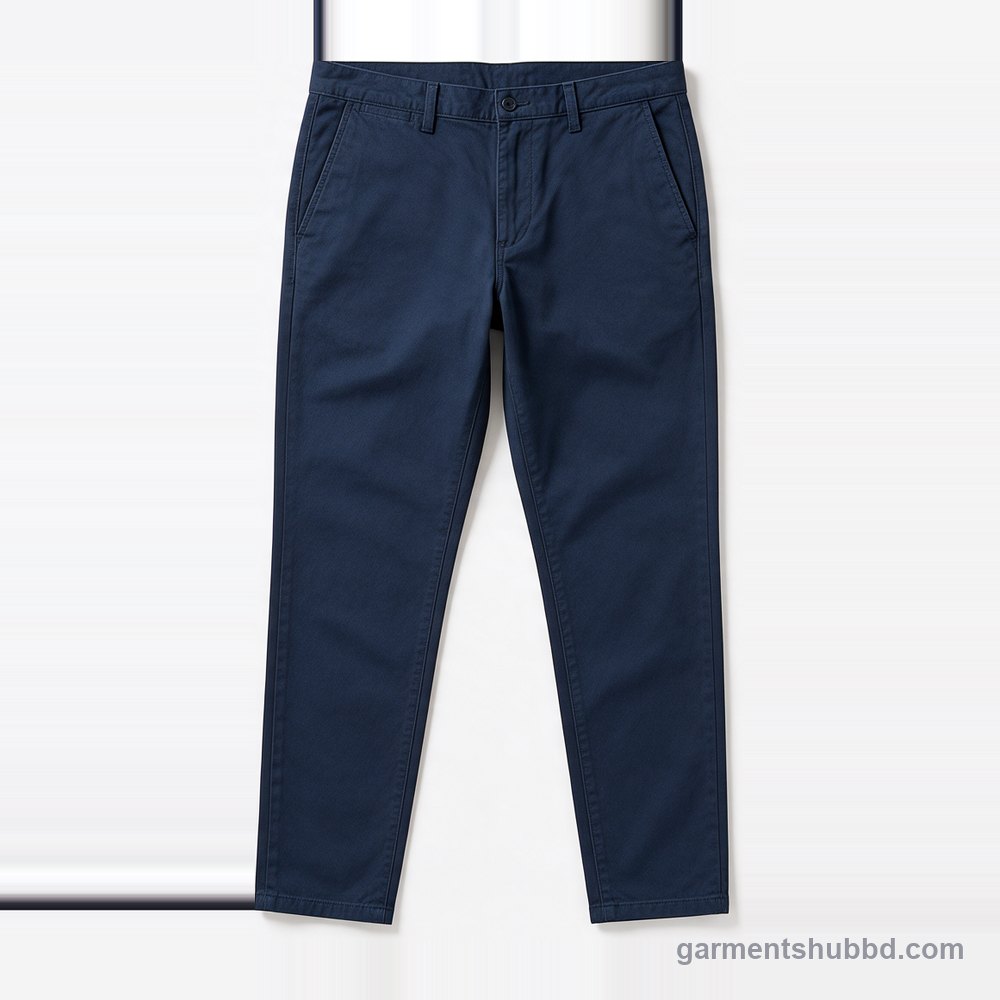
Slim fit chinos, your specification
Made to your tech pack, fabric and colours by a factory matched to the order.
Private label
Your main label, care label, hangtag and polybag. Nominated trims accepted.
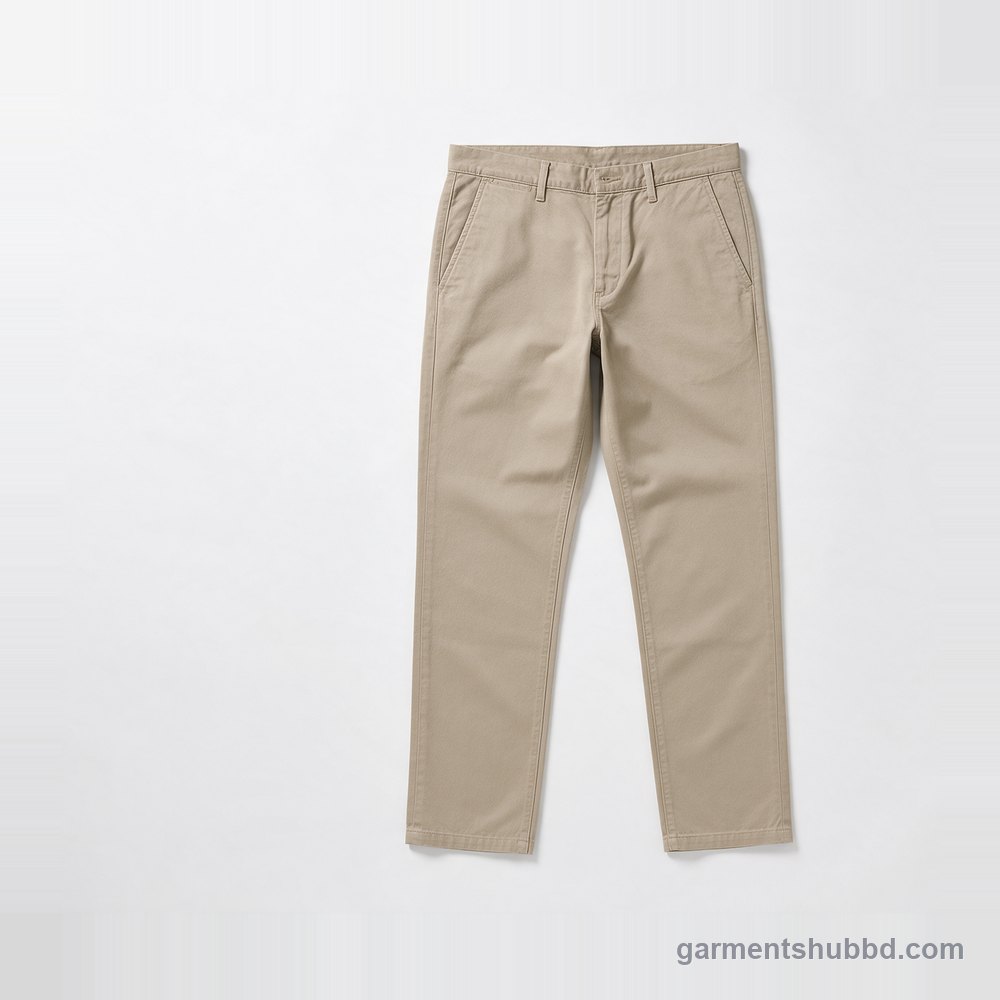
Slim fit chinos follow the leg more closely than a classic cut through the thigh, then narrow from the knee to a smaller opening at the hem. Most are woven with about 2 percent elastane so the closer leg still lets the wearer sit, crouch and climb stairs. A slim fit chinos manufacturer in Bangladesh builds the block from your knee and leg opening, because a waist size alone says nothing about the taper.
Garments Hub BD does not sew; factories on its bench do. The desk writes knee, thigh and opening into the request so both factories price the same leg. An inline inspection during sewing catches a taper drifting off the pattern, and the final random inspection at 80 percent packed measures the leg again, with photographs that are yours.
Kinds of slim fit chinos
Slim taper
Trim through the thigh with a steady narrowing from knee to hem. The core slim style of a mainstream menswear range, nearly always in 2 percent elastane twill.
Extra slim
A narrower thigh and an opening close to the foot. It sells to a younger customer, needs the elastane, and needs a tighter tolerance at the hem.
Athletic taper
Extra room in the seat and upper thigh for a muscular build, then a sharper taper below the knee. For brands whose customers find a standard slim tight at the top.
Rigid slim
A slim cut in 100 percent cotton twill with no elastane. It needs more ease at thigh and seat to stay wearable, and suits buyers who want an all cotton label.
What a slim fit chinos manufacturer in Bangladesh needs from you
- Knee
- The knee width and the point it is measured, a set distance below the crotch. On a slim leg a 1 cm change at the knee alters the whole silhouette.
- Leg opening
- The hem width measured flat. On a size 32 a slim opening is typically 17 to 19 cm, against roughly 20 cm or more on a classic leg.
- Thigh
- Measured usually 2.5 cm below the crotch point. A thigh cut too tight against the taper makes the leg twist on the body.
- Elastane share
- Normally 2 percent, in the weft, with a recovery figure so a narrow knee does not bag by evening. State the share so the mill books the right yarn.
- Tolerances
- Tighter at knee and hem than at the waist, often plus or minus 0.5 cm, because the eye reads small changes on a narrow leg.
- Seat seam stitch
- A chainstitch or a stretch thread on the back rise lets the seam give with the cloth, so stitches do not crack when the wearer sits.
Tests for slim fit chinos
- ISO 13935
- Seam strength. A close leg loads the seat and inseam each time the wearer bends, so ask for the result on the back rise seam in particular.
- ISO 13936
- Seam slippage, where yarns drift apart beside a seam under strain. A tight seat in a smooth, fine twill is where it appears first.
- ISO 12947
- Martindale abrasion. On a slim leg the inner thighs rub together with every step, and that is where a worn chino usually fails.
What moves the price of slim fit chinos
- Elastane twill costs more per metre than rigid cotton twill of the same weight.
- A narrow leg nests tightly in the marker, so cloth per piece is often slightly lower than a classic.
- Chainstitch or stretch thread on load seams, and the machine set up it needs.
- Tight knee and hem tolerances, which mean more measuring and more pieces rejected at the margin.
- An extra fit round when the taper needs a second look on a body.
Lead time for slim fit chinos
Slim fits often take one more fit round than a classic, since knee and hem are judged on a fit model rather than flat on a table; allow 7 to 14 days per round. Once the PP sample is approved, slim bulk takes 30 to 60 days. An elastane twill the mill does not hold in stock adds weaving and finishing days, stated in the quote.
What we check on slim fit chinos before shipment
- Knee and hem on every size drawnThe two figures that define the fit are checked on each sampled size, not only the sample size.
- Leg twistThe side seam should run straight down the leg; on a narrow twill leg any twist pulls it towards the front and shows at once.
- Back rise stitchesThe seat seam is stretched by hand to confirm the stitch gives with the cloth instead of cracking.
- Crotch joinThe point where inseams and rise seams meet is flat and bar tacked, since a slim fit stresses it hardest.
Questions buyers ask about slim fit chinos
What leg opening should a slim fit chino have?
Typically 17 to 19 cm measured flat on a size 32, graded by around half a centimetre per size. Below 17 cm it becomes an extra slim with a different customer. Put the figure on your chart rather than leaving it to the factory's own slim block.
Can a slim fit chino be made without elastane?
Yes, in 100 percent cotton twill, but the pattern then needs more ease through seat and thigh, often 1 to 2 cm, or it binds when the wearer sits. Some buyers choose it for an all cotton composition label.
How is slim fit different from skinny?
A skinny chino follows the leg all the way down to an opening near the ankle bone and usually needs around 3 percent elastane. A slim fit keeps room at the thigh and tapers more gently. They are separate blocks; trimming the hem of one does not make the other.
Can we use our classic chino size chart for the slim fit?
Only for waist and rise. Thigh, knee and leg opening need their own columns and grading, and tighter tolerances. Send both charts if you are buying both fits, so each factory prices them as two patterns.
Get a quote for slim fit chinos
Tech pack or sketch with quantities per colour. A compared quote in 48 hours.