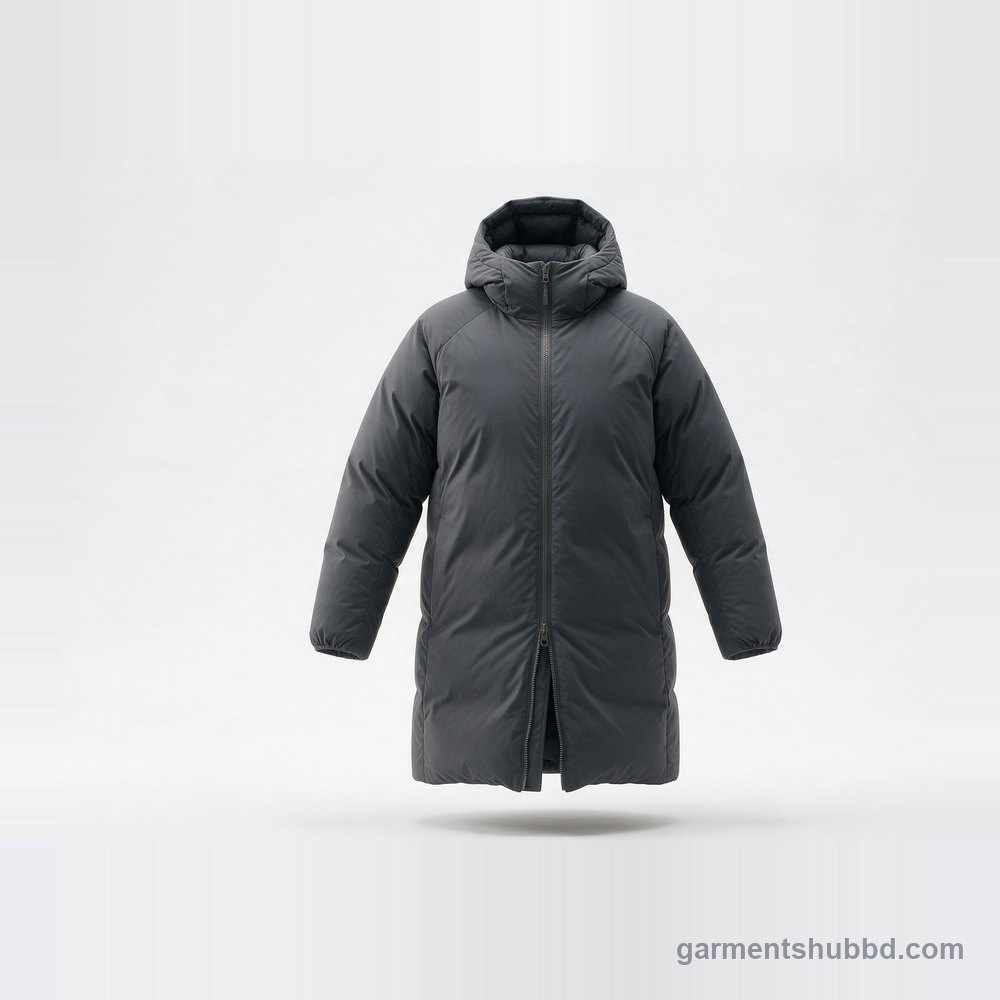
Down parkas, your specification
Made to your tech pack, fabric and colours by a factory matched to the order.
Private label
Your main label, care label, hangtag and polybag. Nominated trims accepted.
A down parka runs to the thigh or below the knee, with 150 grams of fill and often much more, a heavier shell, a two way zip under a storm flap and an adjustable hem. It is bought for real cold: northern city winters and long hours outdoors. A down parka manufacturer in Bangladesh has to place the fill where the body loses heat and stop it drifting down a long panel, while keeping the coat light enough to wear all day.
A parka carries the largest fill cost in the range, and the down is bought before cutting. First orders run on TT, 30 percent with the confirmed proforma invoice and 70 percent against shipping documents, or by letter of credit; no production starts on a promise. Garments Hub BD sends the parka to two factories on its bench so you see two prices on the same fill.
Kinds of down parka
Thigh length city parka
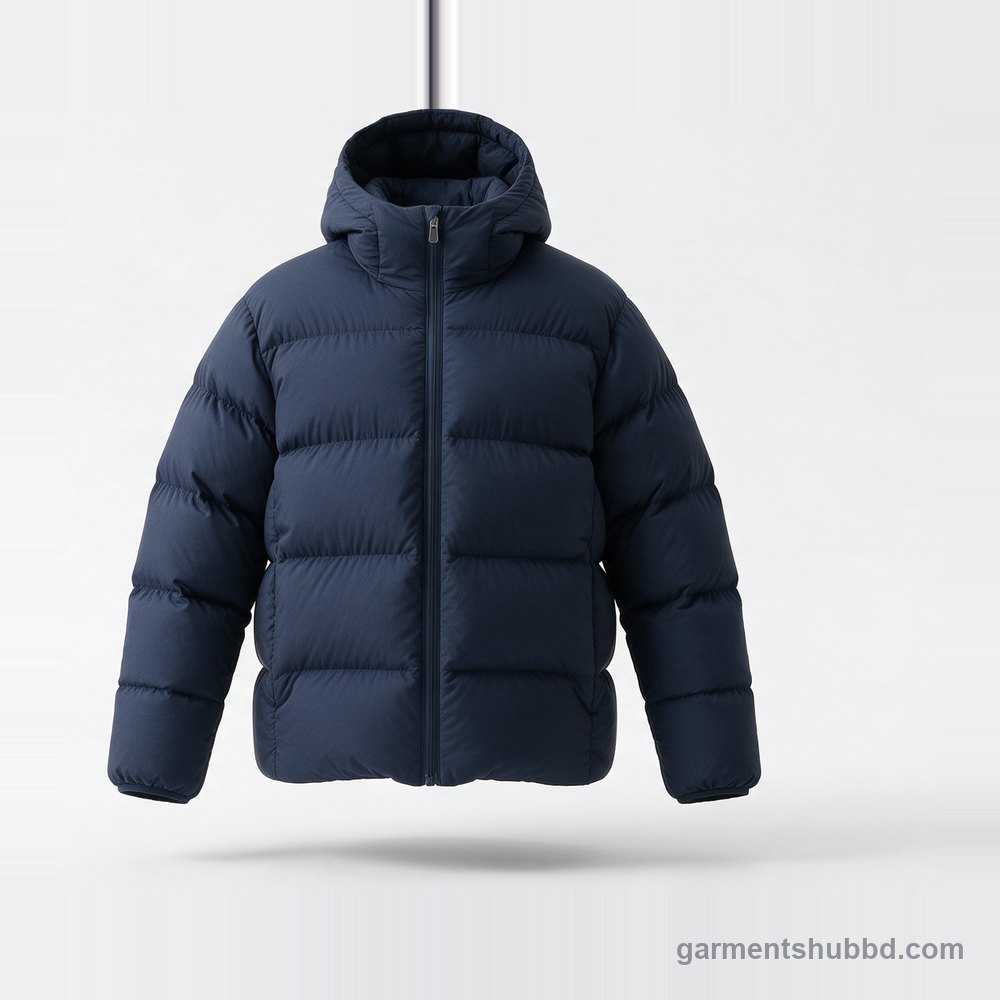
Mid thigh, a clean shell and a fixed or detachable hood. The volume parka for urban winters, usually with 150 to 250 grams of fill.
Knee length down coat
A long body, often with a back vent so the wearer can stride. Fill spreads over a large area, so the baffle pattern decides whether the hem stays warm.
Waterproof shell parka
A laminated or coated outer over a separately sewn down inner, so the outer can be seam taped. Dearer, and the choice for wet, cold climates.
Oversized duvet coat
A loose, very lofty long coat with wide baffles, sold on volume as a fashion piece. It needs plenty of fill to avoid looking flat.
What to send a down parka manufacturer in Bangladesh
- Fill weight by zone
- Grams for body, sleeves and hood separately. A parka usually carries more in the chest and back than in the sleeves.
- Baffle pattern
- Horizontal channels, mixed widths, or box walls in the body. Long panels need narrower baffles or the down drifts towards the hem.
- Shell
- Denier and fibre, typically 50 to 150 denier nylon or polyester, or a cotton nylon blend for a city look. Heavier shells wear better but weigh more.
- Zip and storm flap
- A two way front zip, its gauge, and a storm flap closed with studs or hook and loop tape along its full length.
- Hem and waist
- Drawcord at hem or waist with cord locks, or adjustable tabs. Say where the cord exits and how its ends are secured.
- Weather claims
- A water repellent finish, a waterproof shell with a hydrostatic head figure, or neither. Each claim needs its own test.
Tests for down parkas
- IDFB testing regulations
- Fill power and down to feather ratio. With 200 grams or more in a parka, a few points of ratio move both warmth and cost a long way.
- ISO 811
- Hydrostatic head of a waterproof shell, in millimetres of water. A parka sold as waterproof is usually specified at 10,000 mm or more.
- ISO 11092
- Water vapour resistance, Ret, of the shell. A waterproof parka that does not breathe traps sweat in the down, which then loses loft.
- RDS (Responsible Down Standard)
- Textile Exchange's welfare standard for down and feather: no live plucking or force feeding. The certificate buyers usually ask for behind an animal welfare claim on the tag.
What moves the price of a down parka
- Fill weight: a parka can hold three or four times the down of a lightweight jacket.
- Fill power and the down to feather ratio of that larger fill.
- A laminated or coated waterproof shell, with seam taping on the outer.
- Two way zip, storm flap closures and hem and waist adjusters.
- Length: a knee length coat uses far more shell, lining and down than a thigh length one.
Lead time for down parkas
Parkas sample in 7 to 14 days per round, though two rounds are common to settle fill distribution and length. Parka bulk runs 30 to 60 days after the PP sample is approved. A large lot of down at one fill power, a laminated shell woven to order, or hydrostatic head and breathability tests on the bulk shell each add days.
What we check on down parkas before shipment
- Two way zip and storm flapBoth sliders run the full length, the zip separates and rejoins at the bottom, and the flap covers it completely.
- Hem adjustersCords and cord locks at hem and waist tighten and release, and cord ends are knotted or tacked inside.
- Fill by zoneBody, sleeve and hood fill from a cut sample weighed separately against the zone grams in the spec.
- Back length and hem levelCentre back length measured on each size and the hem checked for level, since a long coat shows any drop.
Questions buyers ask about down parkas
How much down does a parka need?
Usually 150 to 300 grams in an adult medium, depending on fill power and climate. Around 200 grams of 700 fill power is a common city parka specification; arctic styles go higher. Specify grams by zone, not only a total.
Can a down parka be fully waterproof?
Yes, with a laminated or coated shell. Baffle stitching through a waterproof layer would leak, so the outer is usually sewn and taped apart from a down inner. That adds cost and a hydrostatic head test, and the shell should breathe or the down gets damp from inside.
Can we put a temperature rating on the tag?
Only with care. A temperature rating needs lab testing a factory cannot do, and real warmth depends on what the wearer is doing. Most buyers state fill power, fill weight and the down to feather ratio instead, which are testable.
Why does a parka need a two way zip?
A long coat has to open from the bottom when the wearer sits, cycles or gets into a car, or the zip strains and the hem rides up. With a storm flap behind it, the zip also keeps wind out along the front.
Get a quote for down parkas
Tech pack or sketch with quantities per colour. A compared quote in 48 hours.