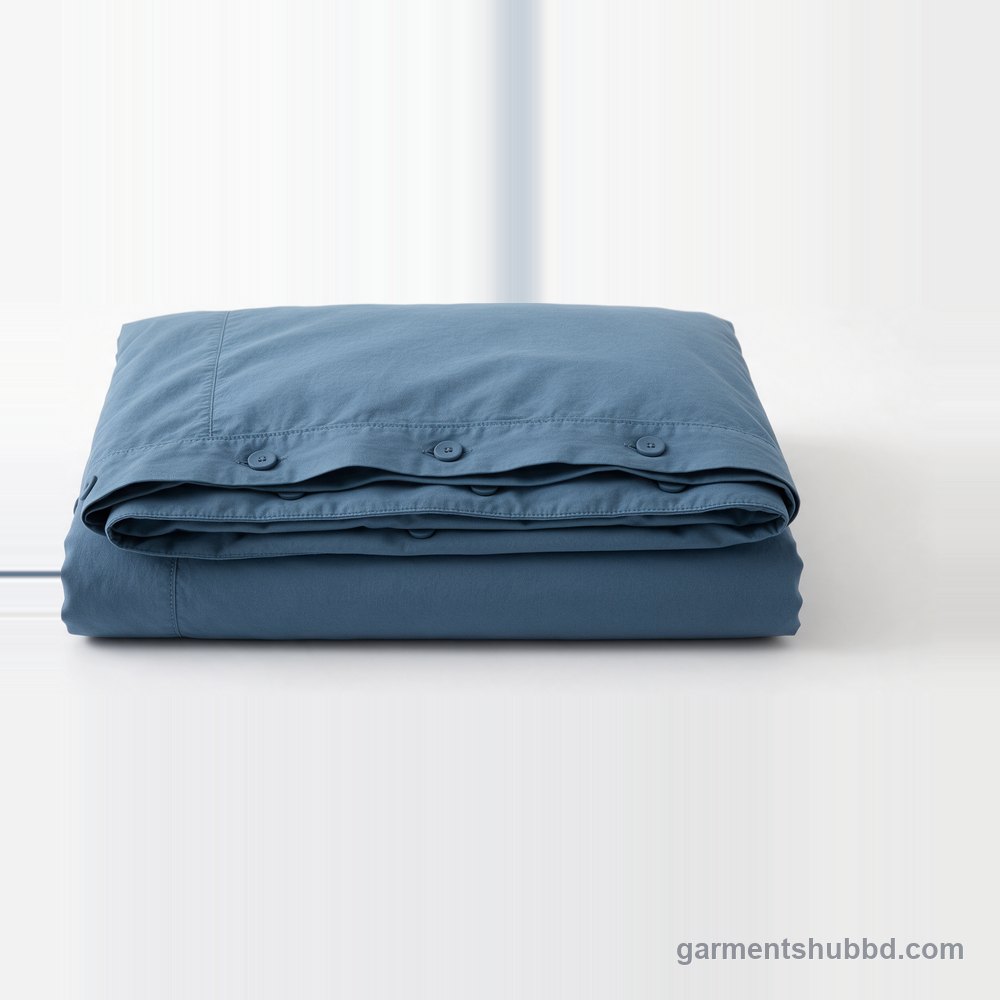
Duvet covers, your specification
Made to your tech pack, fabric and colours by a factory matched to the order.
Private label
Your main label, care label, hangtag and polybag. Nominated trims accepted.
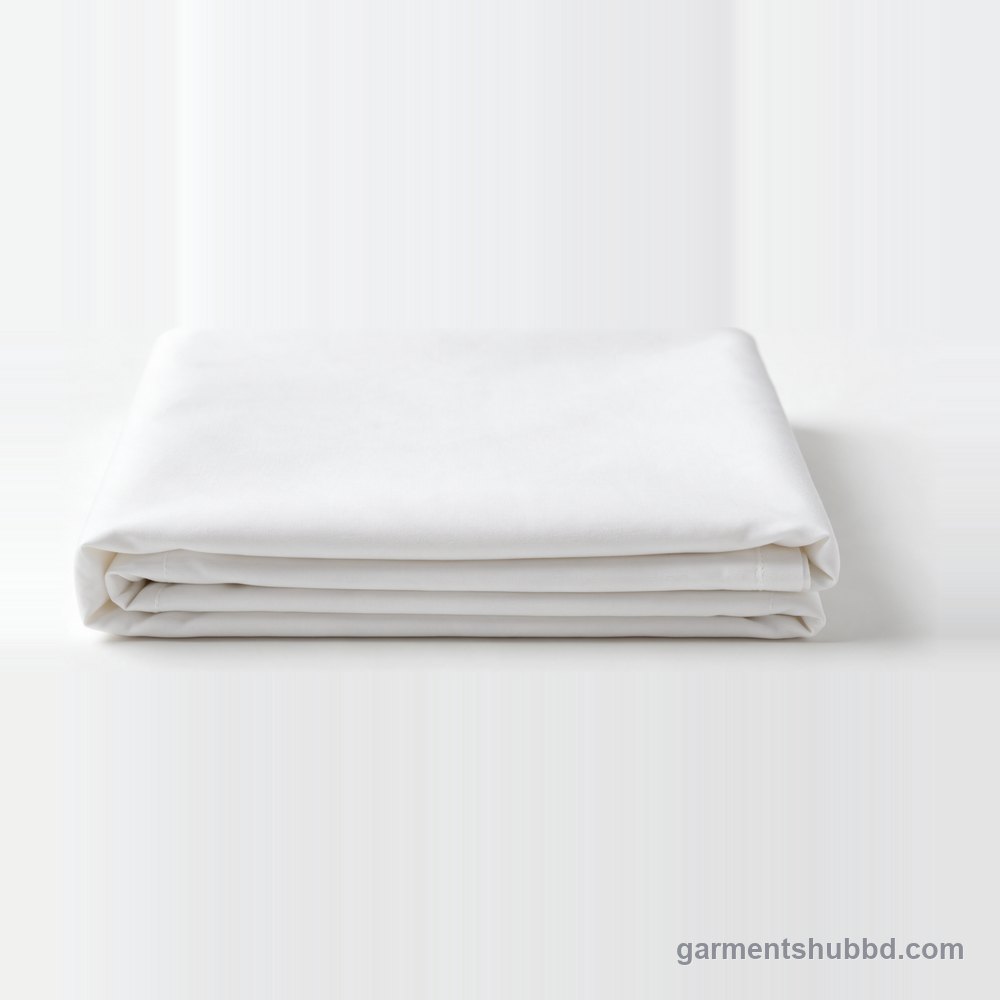
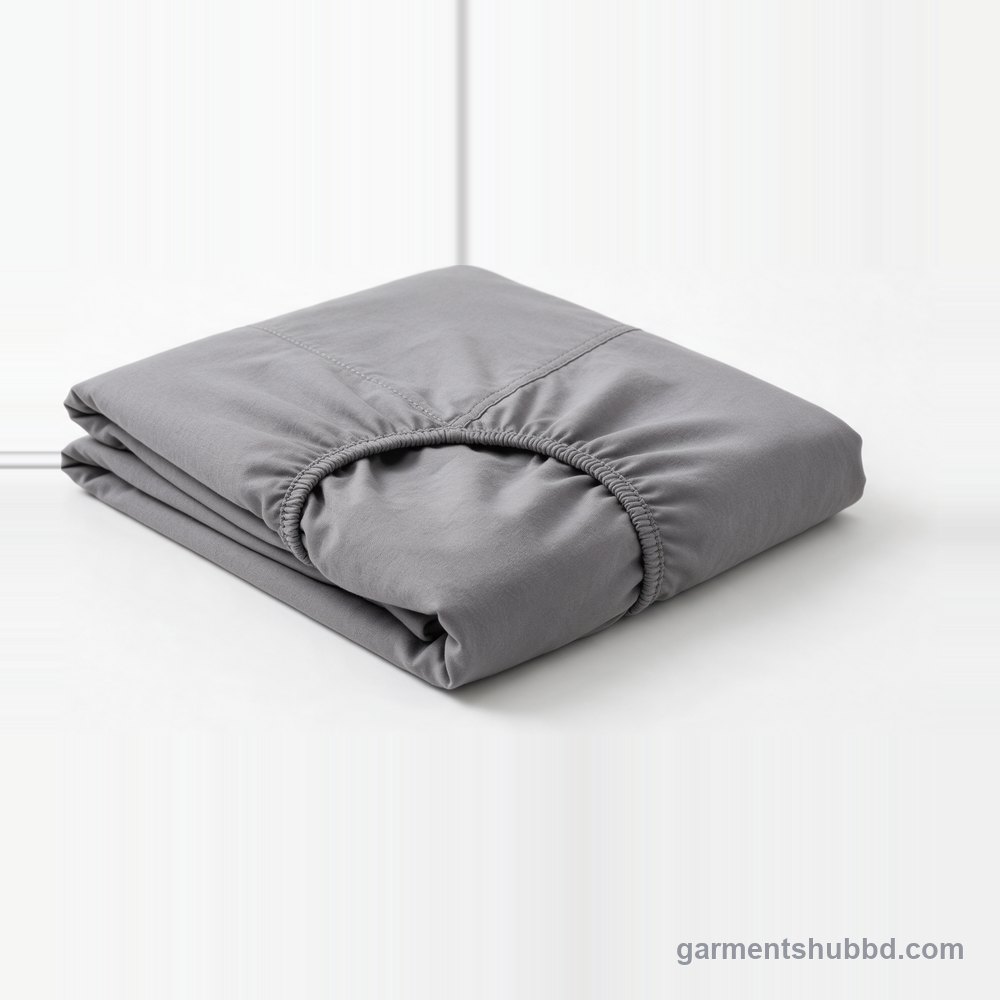
A duvet cover is two panels of sheeting sewn on three sides, with a closure on the fourth to take the duvet in and out. Buyers also search for it as a quilt cover or, in Australia, a doona cover; the product and its specification are the same. A duvet cover manufacturer in Bangladesh spends a large share of the sewing time on that fourth side, so the closure moves the price. Buyers are bedding brands, department stores and online retailers.
The desk looks for a unit whose buttonholing, zip setting or flap folding it has seen running, since the closure line is where a duvet cover order slows down. Your sizes go in by market, with the closure drawn and the tie positions marked, and the fit sample is checked with a duvet inside it.
Kinds of duvet cover
Button closure duvet covers
A row of buttons along a hemmed opening, usually four to six on a double. Buttonholing and button sewing are the slow part. Choose it for classic retail, and name plastic, shell or wooden buttons.
Concealed zip duvet covers
A zip set along the foot under a covering flap, usually stopping short of the corners. Quick for the customer, but the zip is a bought part that can fail. Choose it for higher price ranges.
Envelope closure duvet covers
An inside flap, usually 20 to 30 cm deep, that tucks over the opening with no fastener. Quick to sew, with nothing to break. Choose it for value ranges and covers washed often.
Press stud duvet covers
Plastic or metal studs set by a press at even spacing. Faster to make than buttonholes and firmer than an envelope. Choose it for mid price ranges where a zip costs too much.
Reversible duvet covers
Two different faces, a print and a plain or two prints, so the cover turns over for a second look. Choose it to give one style two looks; both cloths need matched shrinkage.
Briefing a duvet cover manufacturer in Bangladesh
- Sizes by market
- A UK double cover is 200 by 200 cm, EU covers often 135 by 200 or 155 by 220 cm, an Australian queen quilt cover 210 by 210 cm, US covers around 90 inches square for full and queen.
- Closure
- Button, zip, press stud or envelope; the number and spacing of buttons or studs; zip length and where it stops; the depth of any flap.
- Internal ties
- Corner ties, usually four, sometimes with extra ties at the sides on large sizes. Give tie length and whether each is a tape or a loop.
- Fit over the duvet
- The duvet size each cover is for and the finished cover size after washing. Too tight and the duvet bunches; too loose and it slides.
- Panels and print
- Same cloth both sides or a different back, print placement and repeat, and whether the print runs across the closure flap.
- Opening
- Foot end or side opening, and its width, which decides how easily the duvet goes in.
Tests and certificates for duvet covers
- ISO 105-C06
- Wash fastness of the cover cloth, graded 1 to 5 on the grey scales. On printed and reversible covers, ask for staining of the adjacent fabric as well as colour change.
- ISO 5077 with ISO 6330
- Size change after laundering, measured on the made cover. A cover that shrinks squeezes the duvet and strains the closure.
- OCS
- Tracks the amount of organic material in the cover, with no chemical or social criteria. Enough for an organic content claim on the pack; GOTS goes further on processing.
What moves the price of a duvet cover
- Closure: envelope, press studs, buttons and a concealed zip rise in that order in sewing time and parts.
- Button or stud count: each one is a machine cycle and a part, so large sizes cost more than their cloth alone.
- Cloth: two full panels plus the flap, which on large sizes may need wide sheeting.
- Print: a two sided or placed print uses more cloth and screens than an all over repeat.
- Ties: four tape ties are cheap; extra ties or loops add operations.
Lead time for duvet covers
Duvet cover samples usually take 10 to 14 days and bulk 45 to 60 days from the signed PP sample. A zip dyed to match or custom buttons can add days, and a new print needs strike offs approved before cloth is printed. Reversible covers add a second set of lab dips. Dates are fixed in the quote, not before.
What we check on duvet covers before shipment
- Closure functionButtons are fastened, studs opened and closed and zips run end to end on covers sampled from each carton.
- Corner tiesTies are counted, pulled for strength and checked for position against the drawing; a missing tie is a common complaint.
- Panel squarenessCovers are laid flat and measured on both diagonals, since a twisted cover hangs crooked on the bed.
- Print at the openingPlacement is checked where the flap meets the panel, so the print does not jump at the closure.
Questions buyers ask about duvet covers
Is a quilt cover the same as a duvet cover?
For specification, yes. Australia says quilt cover or doona cover, the UK and EU say duvet cover, and some sellers use quilt cover for a heavier stitched cover. Give your market's sizes and the name for your pack, and the cover is specified the same way.
Which closure should I choose?
Choose on price point and use. Envelope flaps are cheap and never break. Press studs and buttons hold better and look retail. A concealed zip is quick for the customer but adds cost and a part that can fail. Many ranges keep one closure across all sizes.
Do duvet covers need corner ties?
Not always, but customers notice when they are missing. Four corner ties stop the duvet sliding to the foot, and some king sizes add side ties. Specify tie length and type; a loop that takes a tab on the duvet is another option.
Can I sell the same cover in the UK and the US?
Not in the same sizes. UK covers follow metric duvet sizes, while US covers follow comforter sizes in inches. The cloth and print can be shared, with separate cutting plans, labels and packs for each market.
Get a quote for duvet covers
Tech pack or sketch with quantities per colour. A vetted unit and a real quote, or a straight no, within 5 working days.