Hi-vis vests, your specification
Made to your tech pack, fabric and colours by a factory matched to the order.
Private label
Your main label, care label, hangtag and polybag. Nominated trims accepted.
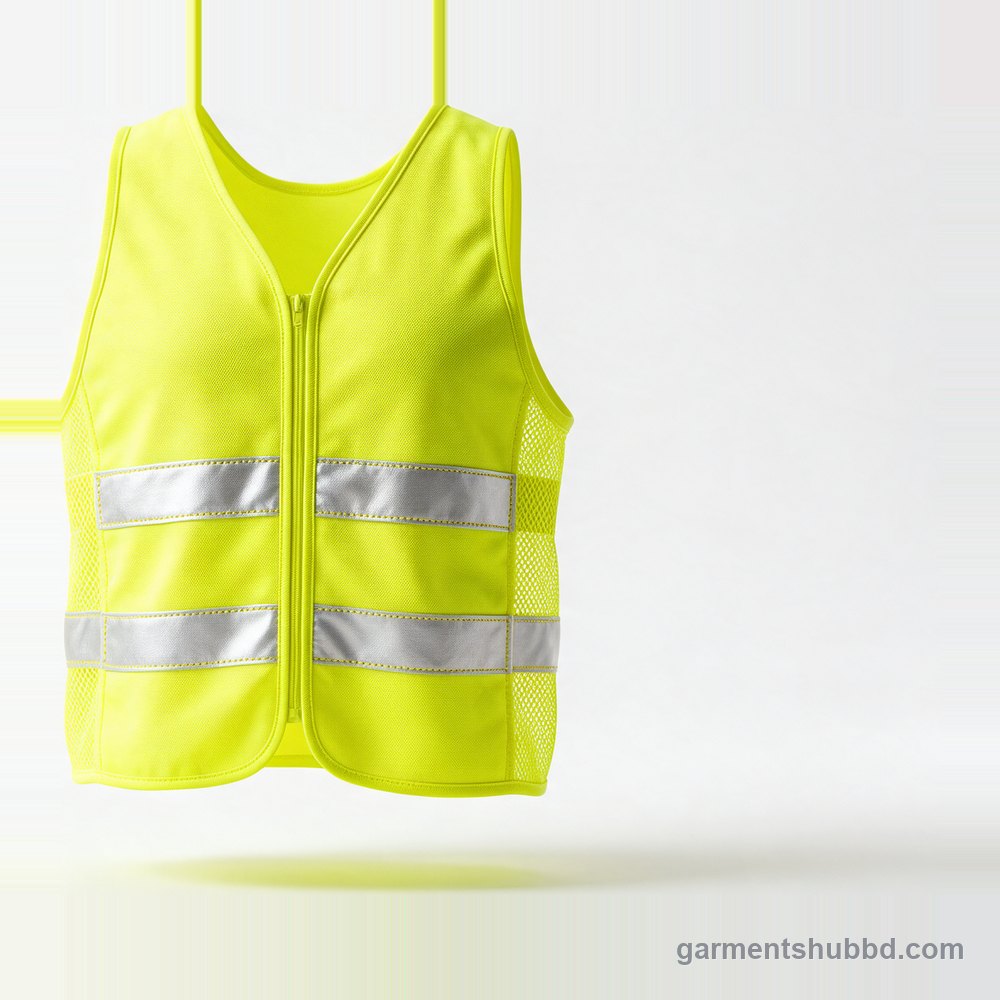
A hi-vis vest is the simplest piece of high visibility clothing: a fluorescent body that stands out by day and retro reflective tape that returns headlights at night. Road and rail contractors, warehouses, event teams and councils buy it in volume. For a hi-vis vest manufacturer in Bangladesh the sewing is quick; the real work is matching fabric, tape and layout to the standard the end customer will check.
The desk asks for the standard, class and colour on the enquiry and sends the vest to two bench factories that sew workwear, with fabric and tape specified to that standard. A new test report, when you need one, goes into the timeline from the quote form. Before packing, inspection measures tape positions against the approved layout.
Kinds of hi-vis vest
Hook and loop front vests
Knitted polyester with two hoops of tape round the body and braces over the shoulders, closed with hook and loop. The volume vest for sites, visitors and events.
Zip front executive vests
Fluorescent or two tone body with a zip front, clear ID pocket, pen and phone pockets and sometimes a radio loop. For supervisors, surveyors and marshals who carry kit.
Mesh vests
Open knit fluorescent mesh for heat and warehouse work. It must meet the same colour requirements as solid fabric, so it is bought as certified hi-vis mesh, not cut from sports mesh.
Breakaway vests
Hook and loop joins at shoulders and sides that part under a sharp pull, for people near moving machinery or traffic where a snagged vest is a hazard. Often asked for on US public safety vests.
Flame retardant hi-vis vests
Fluorescent FR fabric with FR tape and thread, for utilities and petrochemical sites. The visibility claim and the flame claim are each tested on the finished vest.
Briefing a hi-vis vest manufacturer in Bangladesh
- Standard and class
- EN ISO 20471 or ANSI/ISEA 107, with the class and, for ANSI, the type. This one line decides fabric, tape area and layout.
- Fluorescent colour
- Fluorescent yellow (yellow-green in ANSI terms), orange-red or red. An ordinary bright yellow dye does not pass the colour test.
- Retro reflective tape
- Glass bead or segmented tape, usually 50 mm wide, sewn or heat applied, with its certificate and the wash cycles it is rated for.
- Tape layout
- Two hoops with braces, or the crossed back some US designs use. Send a drawing with heights and gaps in each size.
- Closure and pockets
- Hook and loop, zip or press studs; ID window, pen slots, phone pocket. Pockets in a non fluorescent material reduce the area that counts.
- Logo printing
- A printed logo covers fluorescent cloth. Keep it inside the area the design can lose and still hold its class, in an ink that survives the rated washes.
Standards and tests for hi-vis vests
- EN ISO 20471
- Classes 1 to 3 by minimum area of fluorescent background and retro reflective material. Class 3 needs banded sleeves or full length trouser legs as well as a torso, so a vest on its own reaches class 2 at most.
- ANSI/ISEA 107
- The US standard, with types for off road, roadway and public safety work and classes by area. Road crew vests are usually type R, class 2.
- EN ISO 13688
- Sizing, marking and innocuousness rules that sit under EN ISO 20471 when a vest is sold as protective clothing in the EU.
- ISO 105-B02
- Fluorescent dyes fade in sunlight, so ask for the light fastness grade, out of 8, on the bulk cloth of vests worn outdoors all day.
What moves the price of a hi-vis vest
- Certified fluorescent fabric and tape; on a simple vest the tape is often the larger cost line.
- Tape type: segmented and heat applied tapes cost more than sewn glass bead tape.
- Closure and pockets: a zip executive vest has many more parts than a hook and loop vest.
- Class and size, since higher classes and larger sizes use more fabric and tape.
- Logo printing, and a test report for each new design.
Lead time for hi-vis vests
A hook and loop vest in certified stock fabric and tape usually runs within 30 to 60 days of bulk after PP approval, inside a typical 60 to 90 days from order to shipment. A new design that needs its own report, asked for on the quote form, adds the laboratory's time, and fabric dyed or tape bought for the order adds supplier days. A design you already hold a certificate for, sewn in the same fabric and tape, needs no fresh test.
What we check on hi-vis vests before shipment
- Tape position against the layoutHoop heights, band gaps and brace positions are measured against the approved drawing in each size.
- Tape edgesTape is sewn or bonded flat with no lifting at ends or overlaps, since a lifted edge peels after the first washes.
- Fluorescent shadeBulk cloth is compared with the approved fluorescent standard, because a dull lot can fail the colour requirement.
- Label and pictogramOn a certified design, every vest carries standard, class, size and maximum cleaning cycles on its label, matching the test report.
Questions buyers ask about hi-vis vests
Who certifies a hi-vis vest?
Not the sewing factory. For the EU the design is tested by an accredited laboratory and examined by a notified body, and the brand's declaration rests on that certificate. For the US the brand that puts the vest on the market signs a declaration of conformity to ANSI/ISEA 107 on accredited laboratory test reports. The factory's job is to sew that tested design with the same fabric and tape.
Can one vest meet EN ISO 20471 and ANSI/ISEA 107?
Yes, dual standard vests exist. Colour, fabric and tape must satisfy both, and the layout must meet each standard's rules for band position and area. It is tested to each, so certification costs more than for a single market vest.
Is there a class 3 vest?
Not under EN ISO 20471, where class 3 needs sleeves or trouser legs as well as a torso, and ANSI/ISEA 107 class 3 also needs sleeves. For a class 3 outfit, buyers pair a class 2 vest with hi-vis trousers or choose a jacket.
How many washes does the reflective tape last?
It depends on the tape and how it was tested. The label states the maximum cleaning cycles the design passed, and tape makers rate each tape for home or industrial washing. Industrial laundering is harsher, so state the wash route before the tape is chosen.
Get a quote for hi-vis vests
Tech pack or sketch with quantities per colour. A compared quote in 48 hours.