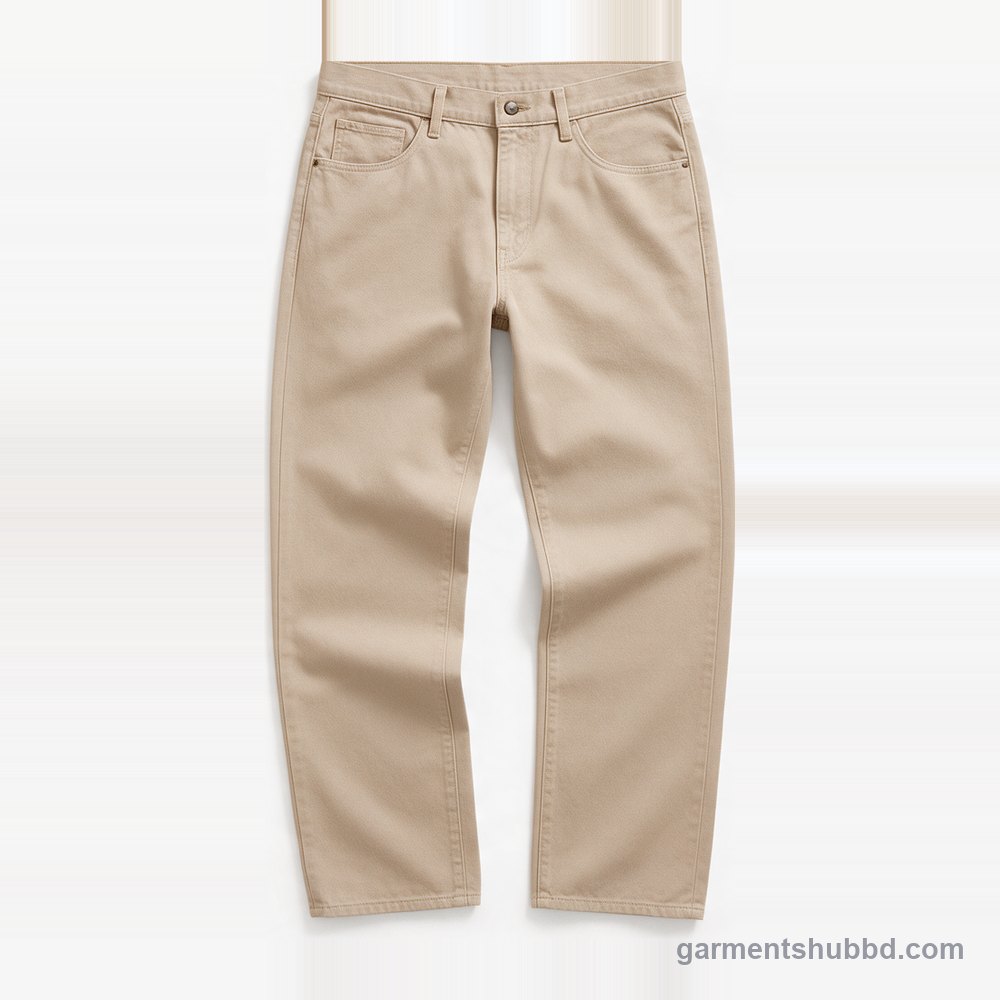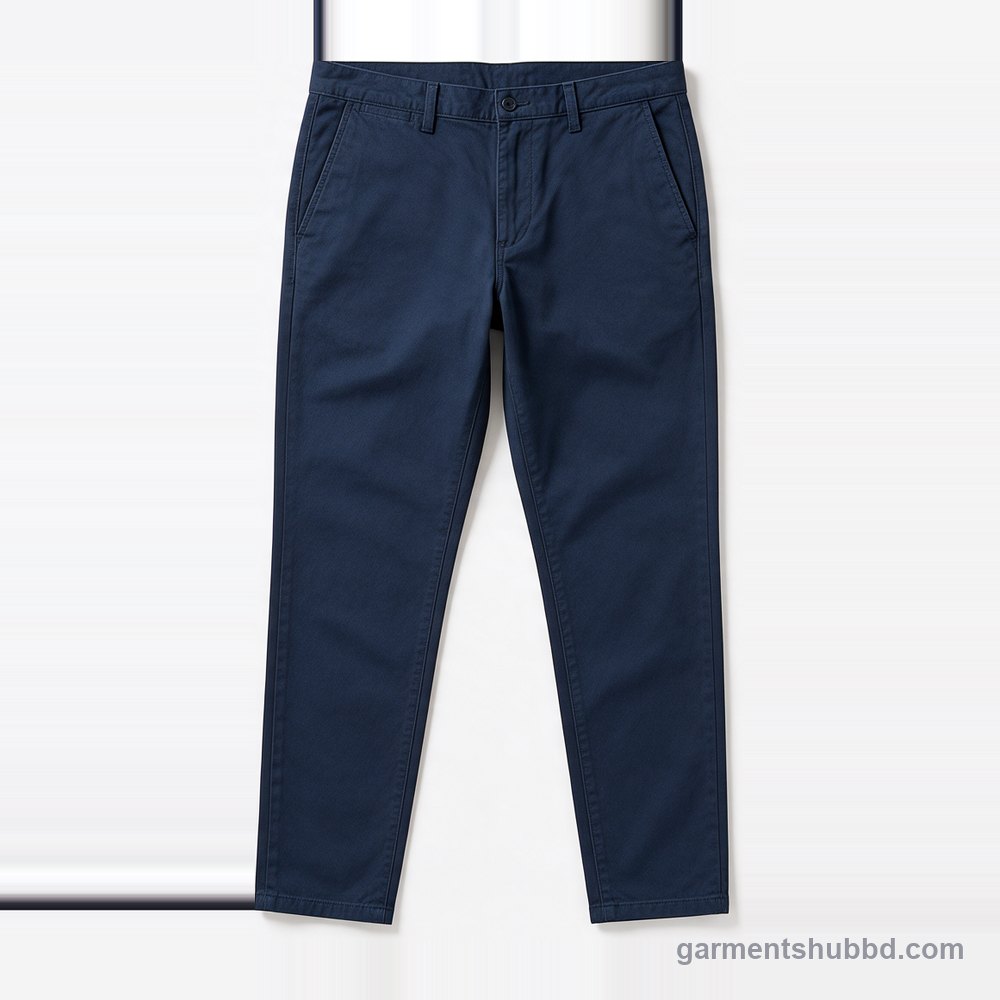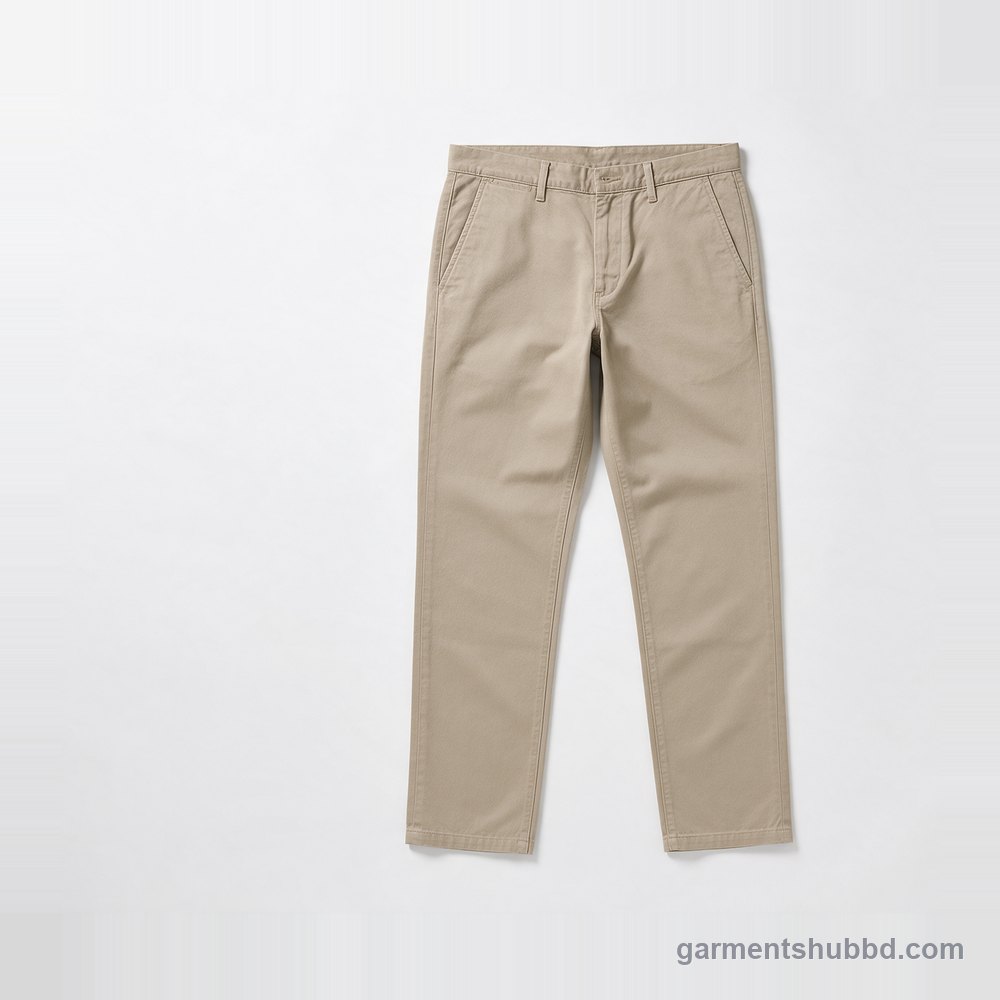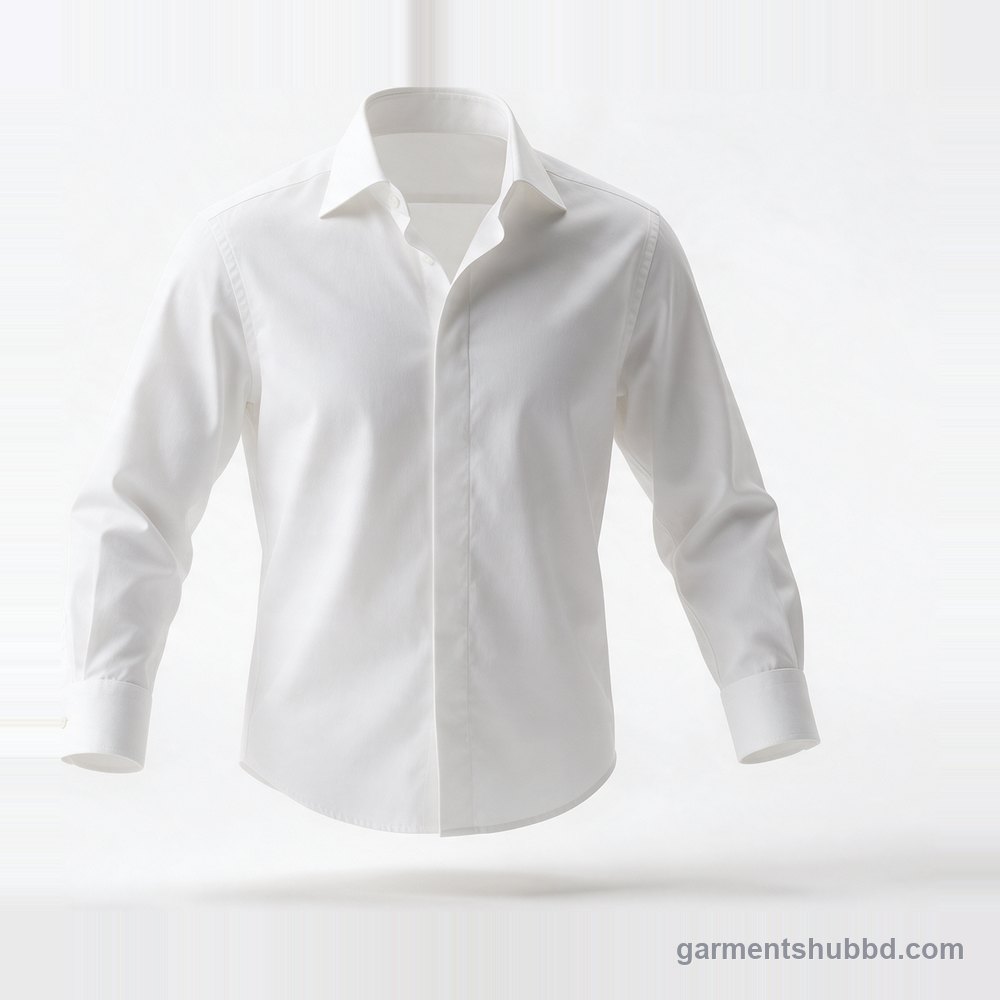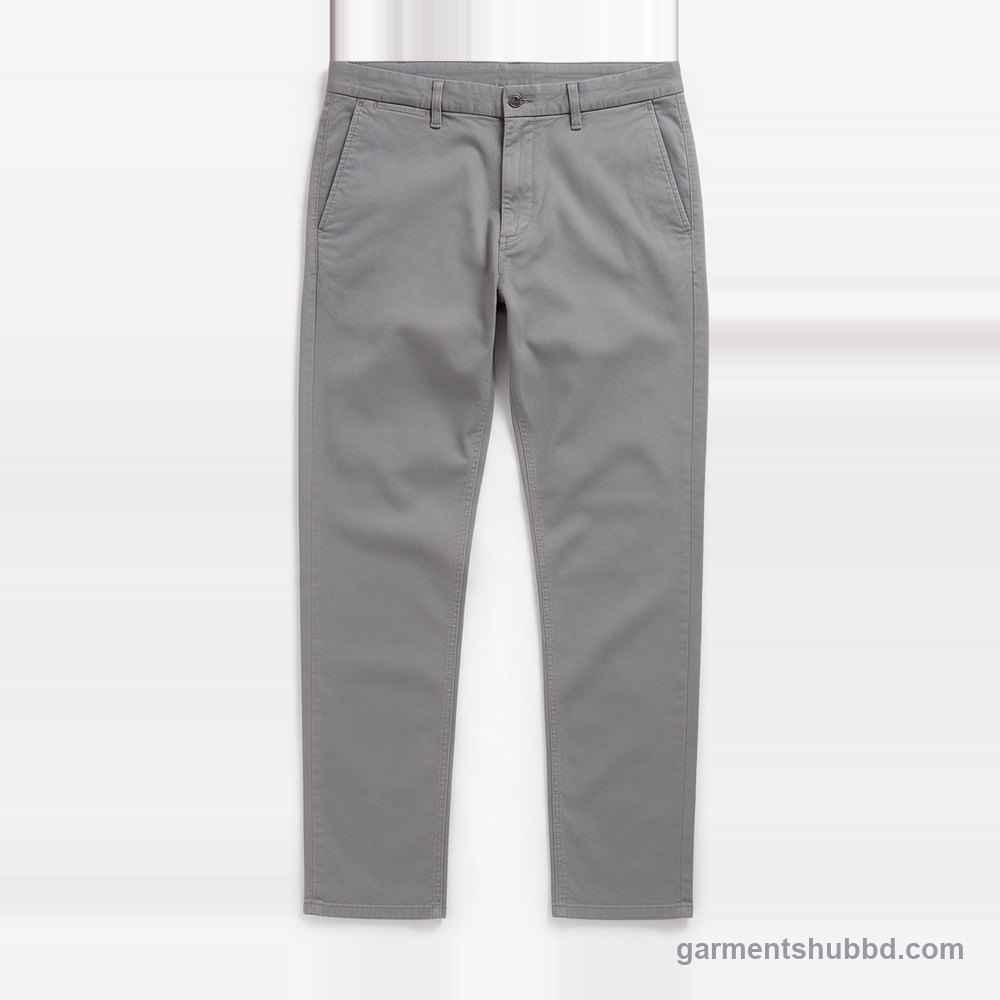
Stretch chinos, your specification
Made to your tech pack, fabric and colours by a factory matched to the order.
Private label
Your main label, care label, hangtag and polybag. Nominated trims accepted.
Stretch chinos are cut from cotton twill with 2 to 3 percent elastane, usually at 240 to 300 GSM, and sold on comfort: commuting, travel, long days at a desk. The usual failure is not too little stretch but too little recovery, which leaves the seat and knees bagged by the afternoon. A stretch chinos manufacturer in Bangladesh controls that through the yarn, the heat setting of the cloth and the pattern, and each needs a number in your spec.
Garments Hub BD sends a stretch chino enquiry to two factories on its bench and sets their quotes side by side on one sheet, priced on the same cloth figures. When your market asks for OEKO-TEX, or for a BSCI or WRAP audited factory, the factories are matched to that need before they quote.
Kinds of stretch chinos
Weft stretch twill
Core spun elastane yarn in the weft only, so the cloth gives across the leg and stays stable in length. The usual stretch chino, at around 2 percent elastane.
Two way stretch twill
Elastane in warp and weft, often 3 percent or more in total. More freedom when bending, harder to hold against growth, and dearer to weave and finish.
Dual core stretch twill
The weft carries an elastane core and a polyester filament core inside the cotton, which improves recovery. Chosen for travel chinos that must look pressed after a day's wear.
Mechanical stretch twill
No elastane: a little give comes from yarn twist and weave. For a 100 percent cotton label, accepting that the stretch is small and the recovery weaker.
How to specify stretch chinos
- Elastane share and direction
- 2 or 3 percent, weft only or both ways. Direction decides where the trouser gives and how the pattern is laid on the cloth.
- Stretch figure
- Extension in the weft at a set load. Comfort stretch on chinos is typically 15 to 25 percent; beyond that the cloth behaves more like a jegging.
- Recovery and growth
- Recovery is how far the cloth returns after stretching; growth is what stays stretched. Ask for both on bulk fabric, after a stated hold and rest time.
- Heat setting
- Elastane cloth is heat set in finishing to fix its width and stop later shrinkage. Ask the mill to confirm it and to state the finished width.
- Waistband stabiliser
- A non stretch interlining or tape inside the band stops the waist growing through the day as the body of the trouser gives.
- Wash limits
- Hot or harsh washes weaken elastane. If the trousers are garment washed, set a temperature ceiling and test stretch after the wash.
Tests a stretch chinos manufacturer in Bangladesh should run
- Stretch, recovery and growth
- The lab extends the cloth to a set load, holds it, releases it and measures what remains. Agree the method and the pass figure with lab and factory before bulk.
- ISO 5077 with ISO 6330
- Dimensional change in washing. Elastane twill that was poorly heat set shrinks across the width as well as the length, so ask for both directions.
- AATCC 135
- The US method for fabric shrinkage after home laundering, which many American buyers ask for on stretch twill instead of the ISO method.
What moves the price of stretch chinos
- Yarn type: dual core yarn costs more than single core spun elastane at the same share.
- Two way stretch, which needs elastane in both directions and slower finishing at the mill.
- Careful heat setting and width control, a step a cheaper cloth may cut short.
- Lab tests for stretch, growth and shrinkage on each lot of fabric.
- Waistband stabiliser tape and stretch thread on the seams that take load.
Lead time for stretch chinos
Stretch twill is often woven to order rather than held in stock, which can add weaving and finishing days before cutting. From there, sampling takes 7 to 14 days and a stretch chino order 30 to 60 days of bulk after PP approval. A growth test on the bulk fabric lot adds a few days, so book it when the cloth is ordered; the quote shows it.
What we check on stretch chinos before shipment
- Growth report on the cut lotThe growth result covers the fabric lot actually cut, not the development sample, and meets the agreed figure.
- Needle damageSeams checked for cut elastane and skipped stitches, which show as tiny holes or grinning along the seam line.
- Relaxed waistbandThe waistband measured relaxed and again after a hand stretch, to catch a band that grows with the body.
- Width after washingWashed pieces measured across thigh and hem to catch elastane cloth that was not heat set properly.
Questions buyers ask about stretch chinos
Should we choose 2 or 3 percent elastane?
2 percent for a chino that should drape like cotton twill with some give. 3 percent for a closer fit or more movement, with more growth risk and a higher cloth price. Most mainstream stretch chinos use 2 percent in the weft.
What is seat bagging and how is it prevented?
Seat and knees stay stretched after wear because the cloth has not fully recovered. It is prevented by yarn choice, proper heat setting and a growth limit in the specification, then checked on the bulk fabric. A looser pattern does not cure it.
Can stretch chinos be garment washed?
Yes, within limits. Elastane loses recovery in hot or long washes, so the recipe needs a temperature ceiling and stretch and growth should be retested on washed pieces. Moderate enzyme and softener washes are common on stretch chinos.
How is a stretch chino labelled for the EU and the US?
By fibre percentage, for example 98 percent cotton and 2 percent elastane. In the EU the fibre name comes from Regulation (EU) No 1007/2011, which uses elastane; under the US Textile Fiber Products Identification Act the same fibre is usually labelled spandex.
Get a quote for stretch chinos
Tech pack or sketch with quantities per colour. A compared quote in 48 hours.