Thermal wear, your specification
Made to your tech pack, fabric and colours by a factory matched to the order.
Private label
Your main label, care label, hangtag and polybag. Nominated trims accepted.
Thermal wear is the base layer worn under clothes in cold weather: long sleeve tops and long leggings, sold singly, as sets and in multipacks. The cloth is a brushed back interlock that traps warm air in its raised fibres, or a waffle knit that holds it in small cells. A thermal wear manufacturer in Bangladesh sews it close to the body with flat seams, so fit, seams and softness against skin are what the wearer notices.
Garments Hub BD sends the fabric, blend, seam type and size chart to two factories on its bench, so the quotes compare like for like. Close fitting garments show grading errors at once, so ask for a size set before grading is signed off. The tests behind a warmth or wicking claim are built into the timeline when you name them on the quote form.
Kinds of thermal wear
Brushed back interlock set
A smooth face outside and a brushed face inside; the classic thermal for everyday cold. Usually cotton or cotton polyester, sold as top and bottom sets.
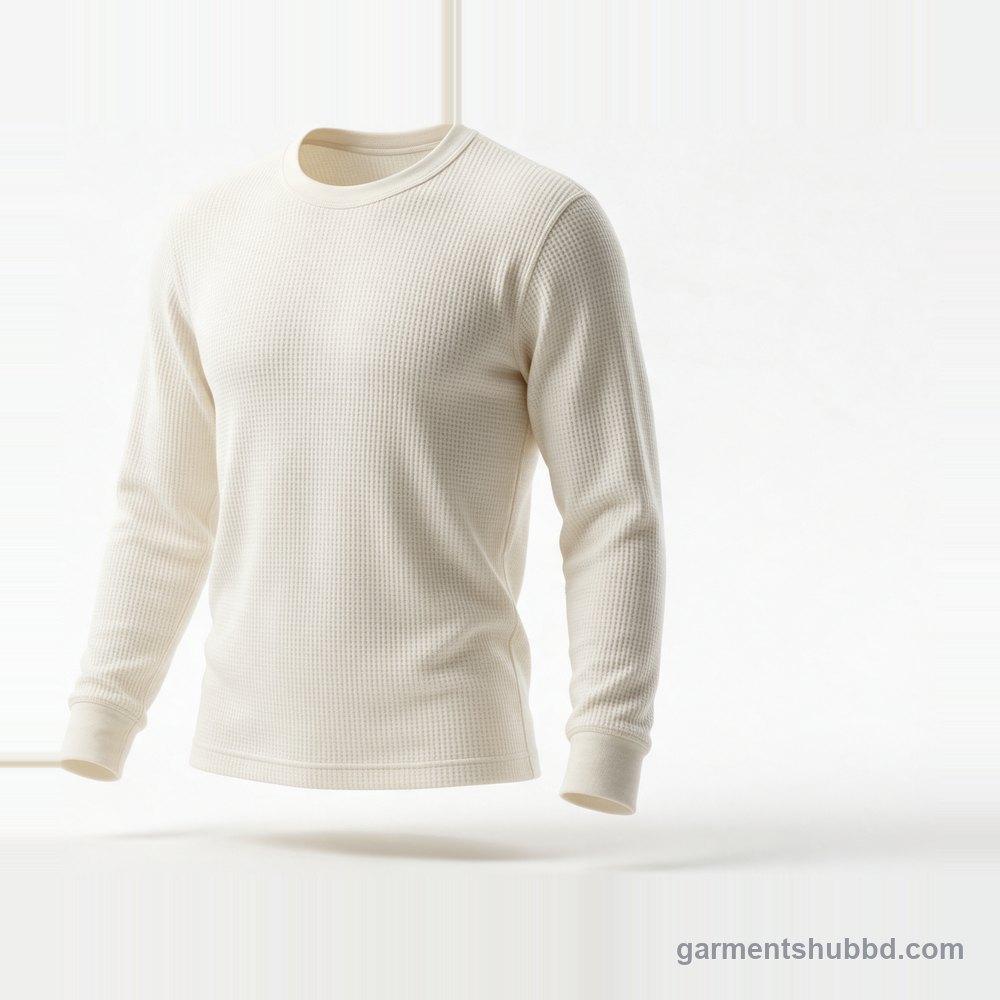
Waffle knit thermal
A textured knit of small square cells that hold air. Cotton or a cotton blend, breathes well, and suits outdoor ranges as a top that can also be worn alone.
Polyester base layer
Brushed polyester, or polyester with elastane, for sport and outdoor use. It moves sweat off the skin and dries fast, so wicking is the tested claim.
Children's thermal set
Scaled tops and long johns in soft cotton blends. In the US, sets sold for sleeping fall under the children's sleepwear flammability rules unless they are tight fitting.
Multipack thermals
Two or three tops or bottoms packed together for value retail. Priced on packing and volume, with colours planned per pack and a barcode for the pack as well as each piece.
How to specify thermal wear
- Fabric and weight
- Interlock or waffle, brushed face, and finished weight, usually 200 to 260 GSM. Give the weight after brushing, since brushing changes the reading.
- Fibre blend
- Cotton, cotton polyester, or polyester with elastane, with percentages. Cotton feels warm and soft; polyester wicks and dries faster.
- Seams
- Flatlock seams, usually four needle six thread, lie flat against skin. Overlocked seams are cheaper but press into the body under clothing.
- Fit and tolerance
- Close fitting but not compressive. Give chest, waist, hip, inside leg and sleeve with a tight tolerance, often 1 cm either way on body measurements.
- Cuffs and waistband
- Rib cuffs and ankles, a covered elastic waistband, and a fly or plain front on the bottoms.
- Labels and packing
- Printed heat transfer labels instead of sewn tags to avoid scratching, plus set or multipack make up and barcodes.
Tests to request from a thermal wear manufacturer in Bangladesh
- ISO 11092
- The sweating guarded hotplate. It measures water vapour resistance (Ret) and also reports thermal resistance (Rct), so a warmth claim can rest on a number.
- AATCC 195
- Moisture management on knit fabric: how fast sweat is moved and spread. Use it for polyester base layers sold on wicking.
- ISO 16322
- Spirality of knits after washing. A twisting side seam on a close fitting garment pulls across the body and shows immediately.
- 16 CFR 1615 and 16 CFR 1616
- US flammability rules for children's sleepwear, sizes 0 to 6X and 7 to 14. Children's thermal sets sold for sleeping must meet them or qualify as tight fitting.
What moves the price of thermal wear
- Fibre blend: polyester with elastane and wicking finishes cost more than cotton or cotton polyester.
- Brushing, an extra finishing pass on the knit, and the weight it is brushed to.
- Flatlock seams, which are slower and need dedicated machines, against overlocked seams.
- Multipack and set packaging, including printed boxes, hangers and pack labels.
- Tests for warmth, wicking or children's flammability, each priced separately.
Lead time for thermal wear
Samples usually take 7 to 14 days on a stock fabric; a custom blend or colour adds knitting, dyeing and brushing time first. Bulk thermals usually take 30 to 60 days after written PP approval. A size set before grading, an ISO 11092 or flammability test, and multipack packaging can each add days. The quote states the timing.
What we check on thermal wear before shipment
- Flatlock seamsSeams are checked for flatness, full cover of raw edges, and stitches that stretch without cracking when the seam is pulled lengthwise.
- Measurements by sizeChest, hip, inside leg and sleeve are measured on sampled pieces in every size against the tight tolerance.
- Waistband recoveryThe waistband is stretched and released to see that it returns to size without rolling or showing the elastic.
- Brushed faceThe inside is checked for even brushing and loose lint, which sheds onto skin and other clothes in the first wash.
Questions buyers ask about thermal wear
Can I call my thermal top warmer than another?
Only with a test behind it. ISO 11092 gives a thermal resistance figure for the fabric, which lets two cloths be compared. Without a result, describe the fabric instead: brushed back interlock or waffle knit, and its weight in GSM.
Cotton or polyester blend for thermal wear?
Cotton or cotton polyester for everyday warmth and softness, where the wearer is not sweating hard. Polyester for active and outdoor use, since it moves sweat away and dries faster. Blends sit in between on price and feel, and a wicking claim needs AATCC 195.
Are children's thermal sets treated as sleepwear in the US?
If sold or marketed for sleeping, yes. They must meet 16 CFR 1615 or 1616, or be tight fitting within the rule's dimensions. Many thermal sets take the tight fitting route, which makes accurate grading essential, since a loose size falls outside it.
How is thermal wear priced in multipacks?
Per pack, built from the piece price, the packaging and the packing labour. Plan colours per pack before ordering, since the minimum applies per colour and a mixed colour pack can mean several colour runs. Ask for pack and piece prices together.
Get a quote for thermal wear
Tech pack or sketch with quantities per colour. A compared quote in 48 hours.