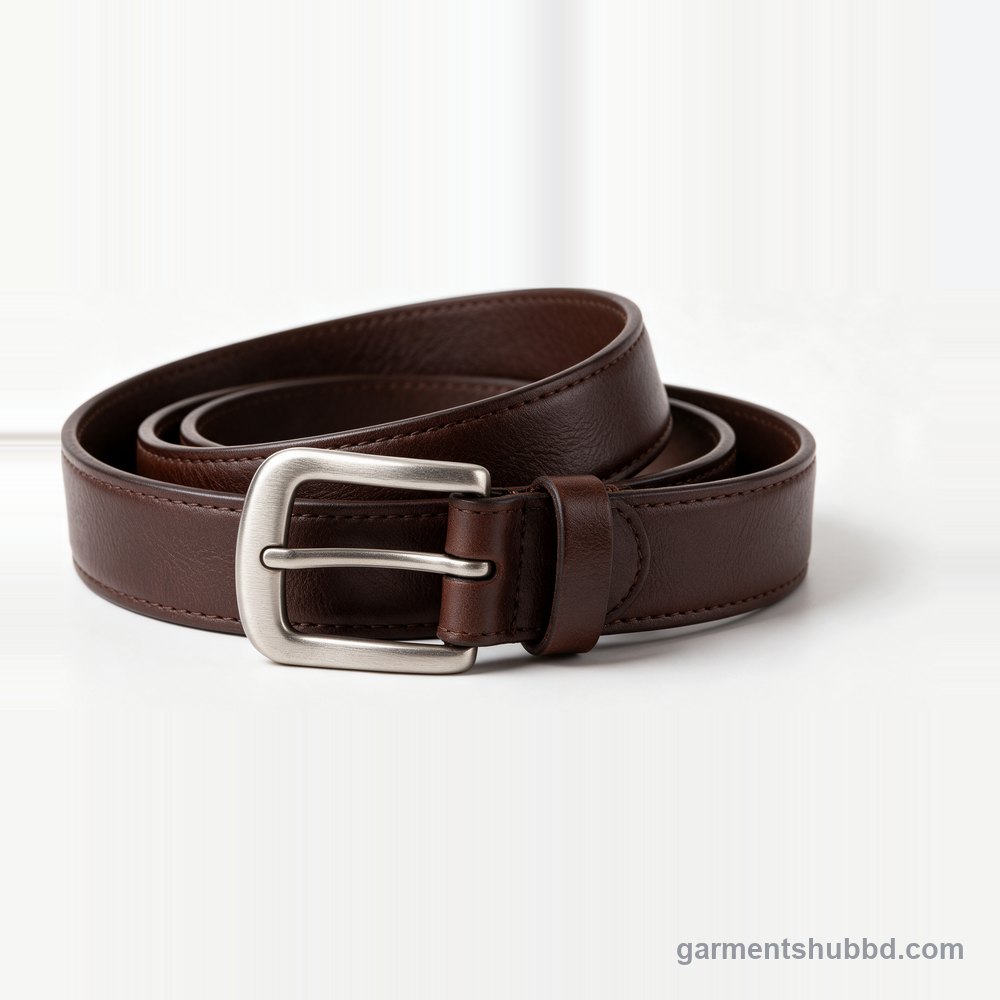
Leather work belts, your specification
Made to your tech pack, fabric and colours by a factory matched to the order.
Private label
Your main label, care label, hangtag and polybag. Nominated trims accepted.
A work belt is a thick, plain belt built to carry weight: a tape measure, a tool pouch, a phone holster or simply heavy work trousers. Workwear distributors, trade suppliers and uniform companies buy it in steady repeat volumes, in black, brown or natural. A leather work belt manufacturer in Bangladesh has to start from the right part of the hide, because a strap cut from stretchy belly leather lengthens under load within months.
Garments Hub BD has no belt unit pre-arranged for heavy straps. The desk finds a unit that already cuts thick bends and sets rivets, vets and visits it, and replies within 5 working days with a real quote or a straight no. For trade buyers, plain bulk packing and a repeatable specification usually count for more than retail presentation.
Kinds of leather work belt
Heavy trouser work belt
38 to 40 mm wide and 4 to 5 mm thick, single ply, with a roller buckle. Holds up loaded work trousers and carries a phone or knife pouch.
Tool belt
45 to 50 mm wide to carry hammer loops, tape clips and pouches, often with a wider back section. Needs very firm leather and riveted fittings throughout.
Two-layer stitched work belt
Two leathers glued and stitched with heavy thread, for stiffness without one very thick strap. The stitching becomes a wear point, so thread size and stitch length matter.
Oiled or stuffed work belt
Leather loaded with oils and waxes, such as latigo or bridle types, to shed water and resist drying out. Darkens with use and stays supple in the cold.
Briefing a leather work belt manufacturer in Bangladesh
- Hide part and thickness
- Cut from the bend or the back, typically 4.0 to 5.0 mm. Shoulder leather is cheaper but creased; belly leather stretches and has no place in a work belt.
- Tannage
- Vegetable tanned or combination tanned for strength and low stretch, and whether the leather is oiled or waxed for wet sites.
- Roller buckle
- A roller on the frame cuts wear on the strap as it is pulled tight. State the metal, steel, solid brass or stainless, and the frame thickness.
- Rivets and screw posts
- Rivets at the buckle fold and the keeper, or screw posts so the buckle can be swapped. Copper rivets with burrs hold harder than hollow cap rivets.
- Holes
- Oval or slot holes so a thick prong passes easily, with count and spacing. Small round holes in a thick strap tear at the prong.
- Edges
- Bevelled on both corners, sanded and burnished, or edge painted. A bevelled edge stops a thick strap from fraying against trouser loops.
- Size range
- Trade ranges often run to large waist sizes; give the top size and the quantity per size.
Tests and certificates for leather work belts
- LWG
- Trade and uniform buyers often run tenders that ask for a tannery rated gold, silver, bronze or audited by the Leather Working Group. Check your tender rules before pricing a programme.
- REACH Annex XVII, entry 47 (chromium VI)
- A combination tanned or chrome retanned work belt leather still falls under the 3 mg/kg chromium VI limit for leather in contact with skin. Ask for a test on each colour and lot.
- REACH Annex XVII, entry 27 (nickel release)
- Rivets and buckles in direct and prolonged contact with skin must not release nickel above 0.5 micrograms per square centimetre per week. Unplated solid brass avoids a nickel plating layer altogether.
What moves the price of a leather work belt
- Thickness and hide part: bend leather costs more than shoulder, and every extra millimetre adds leather.
- Buckle metal: solid brass or stainless steel against plated steel.
- Copper rivets with burrs or screw posts at every fixing, against stitching only.
- Oiled or waxed finishes that add a process after cutting.
- Large sizes, which take longer straps and get fewer belts from each hide.
Lead time for leather work belts
A leather work belt typically samples in 10 to 18 days, and bulk takes 40 to 65 days after pre-production approval. Thick bends in oiled or natural vegetable tanned finishes are not always in stock and can add days, and stuffing leather with oil and wax is slow work at the tannery. Heavy buckles cast to your design need tooling. The quote fixes the dates per size run.
What we check on leather work belts before shipment
- Thickness at three pointsStrap gauged near the buckle, in the middle and at the tip; every reading at or above the agreed minimum, typically 4.0 mm.
- Rivet setRivets fully closed, flush and not spinning; the buckle fold does not shift when pulled hard.
- Roller and prongThe roller turns freely and the prong seats in each hole without forcing or tearing the leather.
- Load testA sampled belt loaded with a weight for a set time; the change in length measured against the agreed limit.
Questions buyers ask about leather work belts
Will a leather work belt stretch when it carries tools?
Very little, if it is cut from the bend of a vegetable tanned or combination tanned hide at 4 mm or more. Stretch comes from belly leather, soft chrome tanned leather and straps that are too thin. Agree a load test on the sample, with a weight and a time, and repeat it on bulk.
Rivets or stitching at the buckle end of a work belt?
Rivets. A thick strap folded at the buckle carries the full pull of the load, and rivets hold it without a stitch line that can wear through. Screw posts are the alternative when wearers swap buckles. Stitching works as a finish there, not as the only fixing.
Can work belts ship bulk packed without retail packaging?
Yes. Trade buyers usually take belts coiled or flat in polybags, packed by size in cartons, with a size sticker on each belt. Give the pack quantity per carton and the carton marks, and add a hang tag only if the belts go onto a shop rail.
Is solid brass worth it over plated steel on a work buckle?
On sites with rain, salt or chemicals, often yes. Plated steel can rust once the plating wears at the roller and the prong; solid brass tarnishes but does not rust. Stainless steel is the other choice. Ask for two buckle grades on the quote and compare them.
Get a quote for leather work belts
Tech pack or sketch with quantities per colour. A vetted unit and a real quote, or a straight no, within 5 working days.