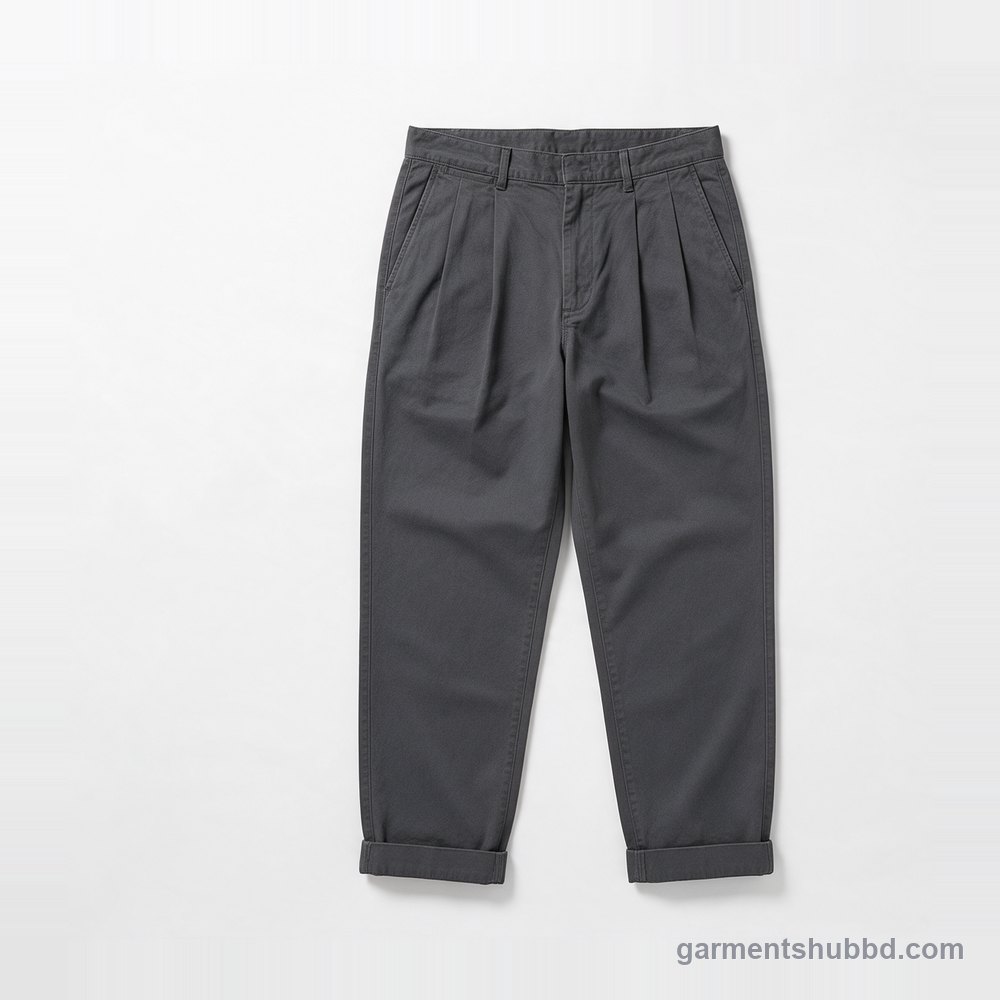
Pleated chinos, your specification
Made to your tech pack, fabric and colours by a factory matched to the order.
Private label
Your main label, care label, hangtag and polybag. Nominated trims accepted.
Pleated chinos have one or two folds at each side of the front waistband, releasing into a fuller thigh that narrows towards the hem. They belong to the relaxed tailored look, worn higher on the waist and often with a crease running from pleat to hem. A pleated chinos manufacturer in Bangladesh has to press and set each pleat so it holds through wear and washing, and build a waistband that keeps the folds closed while the wearer stands.
Garments Hub BD can quote a pleated style two ways. With your own tech pack it is OEM. Without a pleated block yet, ODM starts from a factory's existing pleated pattern with your changes, which usually reaches a first sample sooner. Either way, two factories on the bench quote it, and your pattern is used for your order only.
Kinds of pleated chinos
Single forward pleat
One pleat each side, folded towards the fly. It adds room at the hip without much volume, and is the easiest pleated style to place in a mainstream range.
Double pleat
Two pleats each side, the second smaller and nearer the pocket. A fuller thigh and a stronger relaxed look; it needs a drapier twill to fall well.
Reverse pleat
Folds that open towards the side pockets instead of the fly, the convention on much American tailoring. Suits a vintage inspired range.
Side adjuster pleated
No belt loops; buckled or buttoned tabs at the side seams set the waist. A tailoring detail that changes the waistband build and the trim list.
How to brief a pleated chinos manufacturer in Bangladesh
- Pleat depth
- The fold intake at the waist, typically 2.5 to 4 cm for the main pleat. Deeper pleats give more room and a greater risk of the pleat opening flat.
- Pleat direction and count
- Forward towards the fly or reverse towards the pockets, single or double. Draw it, because factories do not all use the same names.
- Pleat setting
- How each pleat is pressed and fixed: press temperature and steam, and whether a setting agent is used on the cotton. Ask the factory to state its method at the fit sample.
- Pleat length and crease
- Whether the pleat is stitched down for a few centimetres or released at the waistband, and whether the front crease runs on from it.
- Waistband
- Width, extended tab or plain, hook and bar with button, and an inside grip tape that holds a tucked shirt. A loose waist pulls pleats open.
- Rise and thigh
- Pleated chinos usually sit higher, with a longer front rise and a fuller thigh than a flat front. Give both, plus knee and opening.
Tests for pleated chinos
- ISO 6330
- Domestic washing and drying procedures for textile testing. Washing a few pieces to an agreed procedure, then grading the pleats by eye, shows whether they survive a home wash.
- ISO 12945-2
- Pilling by the modified Martindale method. Relaxed tailored chinos are often cut in peached or brushed twill, whose soft surface can pill where the fuller thighs rub.
What moves the price of pleated chinos
- Pleat pressing and setting, done by hand at the press after sewing.
- Extra cloth for a fuller thigh and for the pleat intake at the waist.
- An extended waistband tab, hook and bar, and inside grip tape.
- Side adjusters with buckles or buttons in place of belt loops.
- A drapier or brushed twill chosen so the pleats fall cleanly.
Lead time for pleated chinos
Pleated styles often need an extra fit round, since pleat depth and thigh are judged on a fit model rather than a table; each round takes 7 to 14 days. Bulk on a pleated chino runs 30 to 60 days after the PP sample is approved. A pleat setting trial, or a wash test on pleat retention, adds days before PP sign off.
What we check on pleated chinos before shipment
- Pleat depth and positionEach pleat measured at the waistband against the pattern, both sides matching, so the trouser hangs symmetrically.
- Pleats closed when flatLaid flat, the pleats should lie closed; pleats that spread open point to a waistband or rise problem.
- Pleat into creaseThe pressed front crease runs on cleanly from the pleat, straight down the centre of each leg.
- Waistband hardwareHook and bar aligned with the button, the extended tab level, and the inside grip tape stitched flat.
Questions buyers ask about pleated chinos
Should our pleats face forward or reverse?
Forward pleats, folded towards the fly, are the more common modern choice and sit flatter on a slim figure. Reverse pleats, folded towards the pockets, follow the American convention. Draw the fold direction on the tech pack, since names vary from factory to factory.
How deep should a chino pleat be?
Typically 2.5 to 4 cm of intake for the main pleat, with a second pleat at around half that. Shallow pleats look neat but add little room; deep pleats need a drapier twill and a well fitted waist to stay closed.
Will the pleats hold after washing?
Cotton twill pleats soften with washing, which is part of the look. A careful press at the factory sets them for sale, and some buyers add a setting finish. Agree a wash test on the PP sample and judge the pleat after it.
Do pleated chinos need belt loops?
Not necessarily. Many relaxed tailored ranges use side adjusters or an extended tab instead, which keeps the waistband clean. If you sell with belts, keep the loops and set the waist slightly higher than on a flat front.
Get a quote for pleated chinos
Tech pack or sketch with quantities per colour. A compared quote in 48 hours.