Visors, your specification
Made to your tech pack, fabric and colours by a factory matched to the order.
Private label
Your main label, care label, hangtag and polybag. Nominated trims accepted.
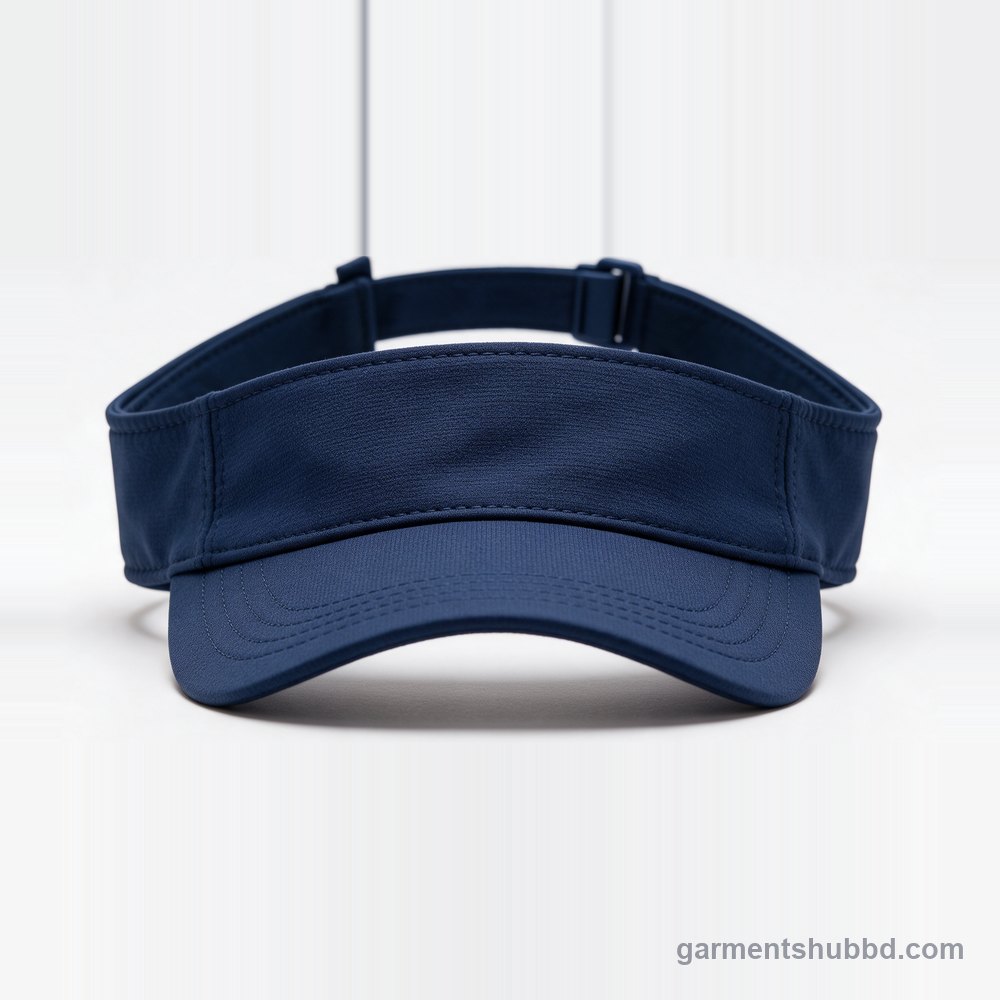
A visor is a peak sewn to a headband, with no crown. It shades the eyes and leaves the top of the head open to the air, which is why golfers, tennis players and runners choose it in heat. With so little fabric, the sweatband and the closure carry the product, and sizing is by head circumference alone. A visor manufacturer in Bangladesh builds it on cap machines from a different pattern. Buyers are golf clubs, sports brands, events and resorts.
The desk looks for a headwear unit that already makes visors, since a band and peak without a crown needs its own pattern and shaping, and visits it. It takes in your head size range, closure, sweatband and logo position on the front band, and checks the fit across the closure range on the sample.
Kinds of visor
Golf visors
A cotton or polyester twill front band, curved peak, terry sweatband and a hook and loop or buckle back. Choose it for club shops and tournaments; the front band takes embroidery.
Performance sports visors
Light polyester with a wicking sweatband, often a perforated band. Choose it for tennis and running in heat; it dries fast and takes heat transfer logos.
Terry towelling visors
The whole band in terry, sometimes the peak too, with an elastic back. Choose it for tennis and resort ranges; towelling soaks up sweat across the forehead.
Wide peak sun visors
A longer, wider peak in stiff fabric for beach and garden use. Choose it for resort shops; the peak shape is the product.
Coil back visors
A plastic spiral band at the back that grips by tension, with no strap. Choose it for quick on and off at events; it fits a narrower range of heads.
Details a visor manufacturer in Bangladesh needs
- Head circumference range
- The head circumferences the visor must fit, small to large, usually around 54 to 60 cm on an adult adjustable, and whether a youth size is needed.
- Closure
- Hook and loop, buckle and strap, plastic snap, elastic or coil, and how much of the range it covers. Hook and loop adjusts in small steps, a snap in fixed ones.
- Sweatband
- Cotton terry, polyester terry or a wicking knit, its width, and whether it runs all round or across the front only.
- Front band height
- The band height in centimetres, which sets the logo space and how the visor sits on the forehead.
- Peak
- Length, curve and stiffness, the insert, and the underside colour; a dark underside cuts glare.
- Logo position
- Embroidery or transfer on the front band, sized to its height, and any mark on the strap.
Tests and certificates for visors
- AATCC 197
- Vertical wicking of the sweatband fabric on performance visors, showing how fast the band draws sweat along the cloth away from the brow.
- ISO 105-E04
- Perspiration fastness on coloured headbands, which sit on wet skin for hours on a course or court; a band that fails stains the forehead.
- ISO 105-C06
- Wash fastness with staining. Sports visors are washed after play, so ask for staining on white terry next to a coloured band.
What moves the price of a visor
- Closure: a coil or elastic back costs less than a buckle and strap with a metal slide.
- Sweatband: a wicking knit or thick terry costs more than a thin cotton band.
- Front band: a taller band with a large or 3D logo means more stitches.
- Peak build: a sandwich layer, contrast underside or extra stitching rows add operations.
- Labour share: with so little fabric, trims and sewing make up much of the price, so cheaper cloth saves little.
Lead time for visors
A visor sample usually takes 10 to 14 days, and bulk usually 35 to 50 days after PP approval. Tournament and event orders should state the event date, since terry dyed to match, custom buckles or club crests with many thread colours add days. The reply says whether the date can be met, and the quote confirms it.
What we check on visors before shipment
- Fit across the rangeThe closure is set at both ends of its range and measured against the stated head range on sampled visors.
- Sweatband stitchingThe terry band is checked for even stitching, no raw edges and no twist along the forehead.
- Peak centredThe peak is checked for centre to the band and an equal curve on both sides.
- Band heightFront band height is measured against the specification and checked for buckling at the peak seam.
Questions buyers ask about visors
What head sizes should an adjustable visor cover?
Adult adjustable visors are usually cut to cover about 54 to 60 cm. A youth visor is a smaller band with a shorter peak. Give the range you sell to, because the closure type decides how much of it one visor can cover.
Terry or wicking sweatband?
Terry absorbs and holds sweat and feels soft; it suits golf and resort use. A wicking knit spreads sweat so it dries faster and suits running and tennis in heat. Some performance visors pair a wicking band with a terry strip at the front.
Can a visor carry a large logo?
Only as large as the front band allows. A visor band is lower than a cap's front panels, so logos are usually wide and short. Give the band height and the logo size together, and approve a sew out on the band.
Hook and loop or buckle for a golf visor?
Hook and loop adjusts quickly in small steps; a buckle with a strap looks smarter and lasts longer. Club shops often choose a buckle or a clean strap end, since hook and loop can catch hair.
Get a quote for visors
Tech pack or sketch with quantities per colour. A vetted unit and a real quote, or a straight no, within 5 working days.